Yin Yang Tattoo Meaning: What to Know Before It Is Permanent

Deciding on a yin yang tattoo meaning comes down to two things you cannot change afterwards: how small the circle can go before the two dots close up, and how a rigid circle behaves on skin that folds. We cut and polish taiji pieces in brass every week, and the same three problems surface on the drawing table long before anyone picks up a needle.
What follows is the yin yang tattoo meaning we would hand a friend: what the symbol commits you to, which parts of the design carry it, and the honest answer about placement.
If you are here for the symbol rather than the ink, our guide to the yin and yang symbol meaning explains the diagram on its own terms.
What Does the Yin Yang Tattoo Meaning Commit You To?
It commits you to one idea: opposition held inside a single whole. Neither half is a rival dividing a circle, and each carries a dot of the other, so the taiji argues that opposites belong together. That is the whole claim, and it survives without a promise attached.
Three classical laws sit behind the drawing. Opposition within unity: the halves define each other. Waxing and waning balance: winter gives way to summer as yin fades and yang grows, which is why the diagram is drawn as movement rather than a fixed ratio. Mutual transformation: extreme cold produces heat, extreme heat produces cold. Read that way, the yin yang tattoo meaning is about change rather than luck.
The two dots are the argument
The dots are load-bearing. Take them out and the shape becomes a decorative spiral with a nice story. At three centimetres they read at arm’s length; at one centimetre they merge into the curve, so the first decision a yin yang tattoo meaning forces is scale, not style.
What the taiji does not promise
It does not promise protection, luck, health or a change in your circumstances. The tradition this shop sits in is the School of Naturalists, the pre-Qin school associated with Zou Yan and the Five Virtues cycle, and its claims are about pattern and season. Ink is ink, and where the sources are silent we stay silent too.
Yin Yang Tattoo Design: Why the Circle Is the Hard Part
A yin yang tattoo design usually fails at the circle before it fails at the concept. A freehand oval reads as carelessness, while a machine-perfect circle can read as clip art, so the versions that work share three traits: one constant line weight all the way round, two dots of identical diameter, and a deliberate decision about whether there is an outline at all. Get those right and the yin yang tattoo meaning is already legible.
We build the shape in metal, and the circle is where the labour sits: someone has to judge whether the mark is heavy enough to survive polishing or light enough to still look drawn. Cutting the outline away so the two masses meet directly is the version that ages best, because there is no thin line left to blur.
Line weight, and where the design usually fails
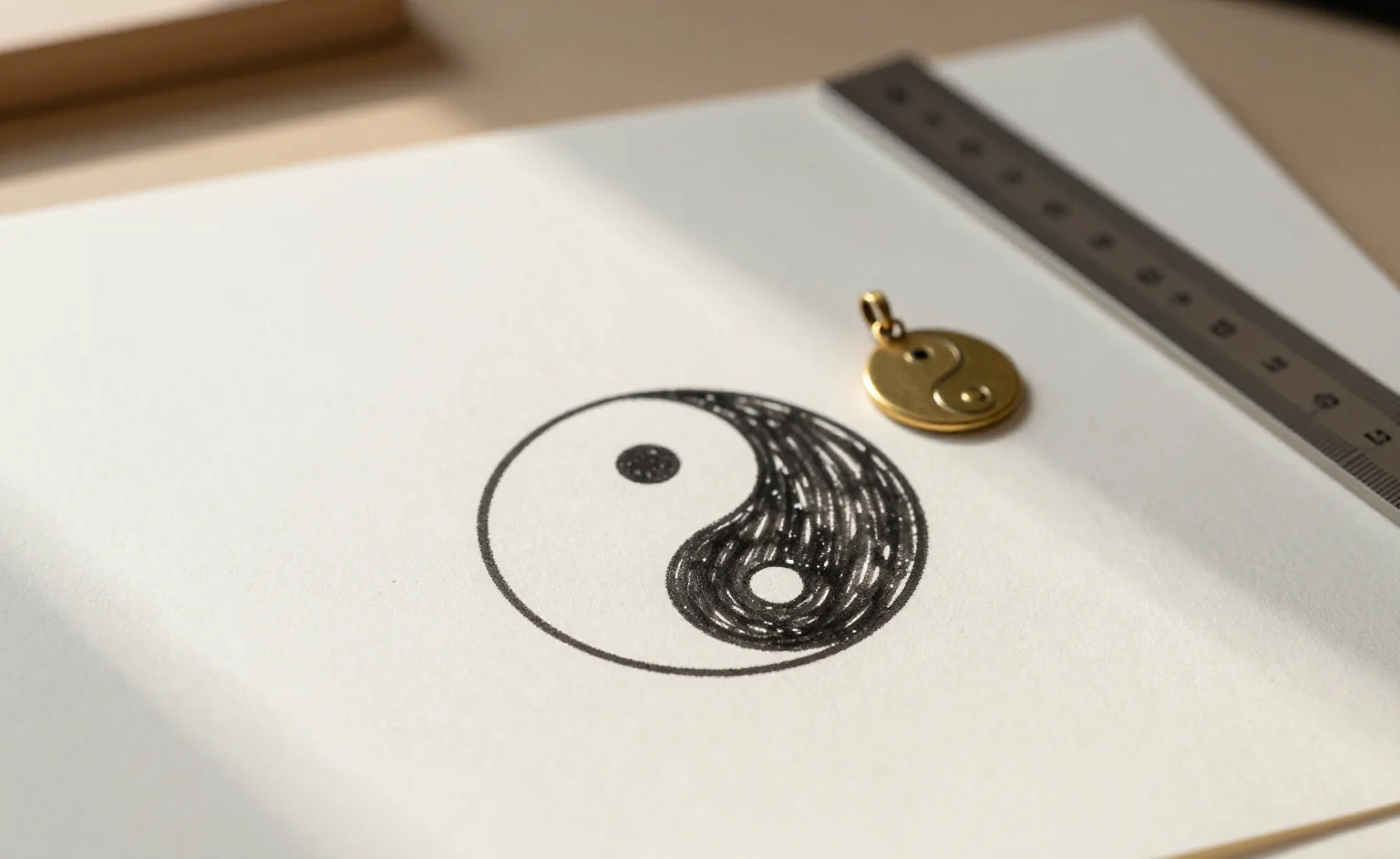
In brass we engrave the taiji at 14 mm with a 0.8 mm bit. Below that the cut closes on itself and the dots fill in under the polishing wheel — not metaphorically, they disappear. Skin behaves the same way, because pigment spreads as it settles, so a dot measuring 1 mm on the drawing can be a suggestion by year five. Thicker line, longer life: that is the trade we make on every piece.
Adding a date, a name or a second symbol
Keep the circle clean and put the extra element outside it, joined by nothing. Anything set inside competes with the dots, and the dots are the part carrying the yin yang tattoo meaning. That is also why we skip the popular trick of turning the halves into animals: at small sizes the animal reads as noise and the circle stops working as a circle.
Small Yin Yang Tattoo: What Still Reads at Two Centimetres
The smallest clean taiji we are willing to put a price on is 14 mm across, and that number came out of a stack of rejected samples rather than a trend list. At 14 mm each dot holds roughly 2 mm of clear space. At 12 mm they begin to fill in during finishing. At 10 mm the yin yang tattoo meaning quietly disappears.
Translated into a small yin yang tattoo, the same arithmetic sets the floor. If you want the dots to stay recognisably dots, plan a 2 mm dot inside a 15-18 mm circle, which sits comfortably on an inner wrist, an outer ankle or the flat of an upper back. A finger is below the floor, and the honest alternative there is a plain circle or a single line: you lose the taiji but keep the intent.
Tattoo Placement Meaning: Does the Spot Change Anything?
In the classical material we rely on, direction and season belong to the five elements, not to skin: east is wood, south is fire, west is metal, north is water. Nothing in that scheme ranks body parts. Tattoo placement meaning, honestly read, is a design question — visibility, friction, sun and how the curve bends.
We are not withholding a secret. The correspondences we use are narrow and documented, and none of them maps onto an arm; nothing in them changes the yin yang tattoo meaning according to where the circle sits. A chart offering a body map of meanings has added that layer afterwards.
What placement does change is how the piece survives. Skin is not paper: it stretches, folds and sits under straps. A taiji needs a surface that stays roughly flat and a spot you can see without a mirror, because a symbol this simple only works if you notice it on an ordinary Tuesday.
Where a small taiji survives best
The good spots are the boring ones: an inner forearm is flat, visible and easy to keep out of strong sun; an outer ankle behaves the same way; an upper back is flatter still. The poor spots are the ones that rub — a waistband edge, a bra strap, a watch. Placement changes durability, not the yin yang tattoo meaning, and that distinction is worth holding on to.
An arm is not a compass
There is a persistent idea that a taiji points somewhere and that the direction is part of the reading. It does not. “South is yang, north is yin” describes orientation in a landscape, exactly as “mountains are yin, water is yang” describes a vista. Rotating either sentence onto a body is a category error.
Black and White Tattoo Symbolism: What Colour Takes Away
Black and white tattoo symbolism is the conservative reading, and here conservative has a technical reason: the diagram is two tones that must stay distinct, and contrast is the only thing keeping the dots legible. Every colour added competes with the element carrying the yin yang tattoo meaning.
The classical taiji is monochrome. Painting one half red or giving a dot a gold centre does not make the piece more traditional; it introduces a claim the source does not make, and the five elements already own a colour vocabulary elsewhere.
Why black ink holds up
Black is the practical choice as well: it keeps its edge longer than other pigments and reads the same way across skin tones, so the drawing survives the years in which a lighter palette would have softened into mush. A taiji has no room to lose detail, because the dots are the detail.
How We Test a Shape Before It Becomes Permanent
Before anything reaches a customer we run the test we would suggest for any yin yang tattoo meaning you intend to keep for thirty years. Draw it at 30 mm, reduce copies to 18 mm and 14 mm, then stand a metre away. The version that still reads at a metre is the size worth taking to an artist.
The test is unromantic on purpose, and it has changed more of our designs than any aesthetic argument. A circle on paper is not a circle on a wrist. This is where our trade-off lives: we would rather lose a dot than thicken it into a blob, and we have refused sizes that would have sold well.
A five-minute paper test you can do tonight
Draw the circle large, photograph it, then view the photo on your phone at about 14 mm. Move the phone to arm’s length. If the dots have gone, you have your answer before you have an appointment. Do it in daylight, and hold the paper against the part of the body you are considering.
Questions People Ask Before They Book
Is it okay to carry a symbol from a culture that is not mine?
We sell these shapes to people outside China, so we are not neutral, but we are consistent. The taiji is a public philosophical diagram rather than a sacred image, so the useful questions are about accuracy and respect: get the structure right, know what the two dots mean, and do not treat the figure as a pattern with no content.
Should the two halves be perfectly symmetrical?
They should be equal, which is not the same thing. A hand-drawn taiji with a slightly irregular curve but two dots of identical size reads better than a mechanical version with mismatched dots. Tell your artist one thing above all others: the two dots have to match.
What if I want to change my mind later?
You cannot, and that is the difference between ink and a pendant. A ring can be re-polished or taken off for a week; a tattoo stays where you left it. Live with the drawing for a month first. The yin yang tattoo meaning that survives a month of ordinary Tuesdays is the one worth keeping.
A Symbol You Carry, Not One That Carries You
That is the reading we keep returning to at 69player, where the whole idea rests on the balance of yin 6 and yang 9: the even, still six and the odd, active nine, each holding a dot of the other. A tattoo of the taiji is that sentence made permanent.
If you would rather wear the shape before committing to ink, the taiji pieces in our collection are cut to the same 14 mm floor for the same reason, and the thinking behind the pattern is unpacked in our 24-hour rhythm guide and in nine ways to restore balance. Start with the size test.