Feng Shui Bathroom: The Room That Is Already Yin

Most feng shui bathroom advice begins with what to place on the shelf. Ours begins with a squeegee, because the room’s problem is rarely decoration: it is water that stays, air that does not move, and a light too cold to sit under. Get those three right and the objects on the counter stop doing the heavy lifting.
We wrote this from a small studio flat with one windowless bathroom, tracking what changed over a few months rather than a weekend. What follows is the order we now do things in, the mirror question, the plants we gave up on, and the popular instructions we could not trace to a source we trust.
Why a Bathroom Is Yin Before You Change Anything
Yin and yang describe conditions, not verdicts. Stillness is yin and motion is yang; cold is yin and warmth is yang; north is yin and south is yang. A bathroom collects several of the quiet ones at once: the air is still, the surfaces are cool, and in most flats the room sits away from the sun. That is the whole diagnosis, and any feng shui bathroom starts from it. Nothing about it is unlucky; it is a room built around water and enclosure.
The line that gets misquoted is that mountains are yin and water is yang. That contrast comes from landscape: a moving river against a fixed slope. A shower tray holding water at room temperature is not a river, and we would not use the landscape line to call a wet room energetic. Keeping that distinction stops a simple pair from turning into a slogan.
Bathroom Yin Energy, Without the Fog
Bathroom yin energy, as we use the phrase, means damp, cool, enclosed and dim — four conditions a bathroom already has. The goal is not to purge the yin; a room that is mostly yin can be restful. The goal is to stop it pooling. Standing water, stale air and a counter crowded with bottles make the room feel heavier than it is. Dry it, air it, clear it, and the same stillness reads as calm instead of neglect.
Does a Feng Shui Bathroom Mirror Belong Above the Basin?
No. Nothing in the material we rely on requires a mirror in a bathroom, and no placement rule we can verify says a mirror must face or avoid the door. A mirror earns its place for two ordinary reasons: it bounces light into a dim room, and it lets you see yourself. Treat it as a tool, not a cure.
That answer disappoints readers who have been told a mirror opposite the door pushes energy out of the room. We are not going to pretend that rule is classical. If a mirror facing the door bothers you, the fix is the same as for any other design problem: move it, or give it something calm to reflect. The discomfort is real; the cosmology attached to it is usually added later.
Where We Put Ours, and Why
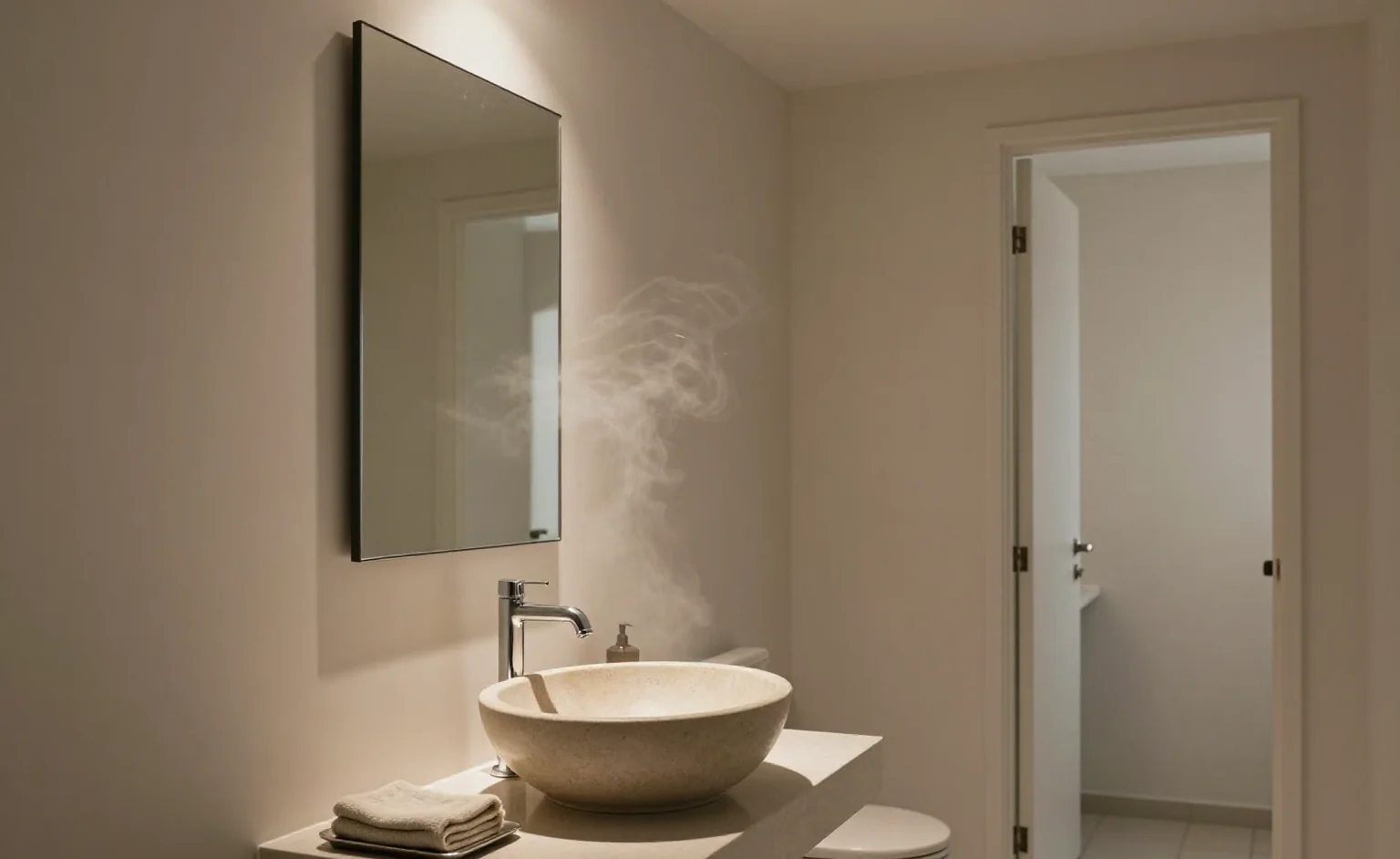
Our mirror sits above the basin and faces a plain wall, which is the least distracting reflection we could arrange. The counter below holds one tray, a soap dish and a folded towel; everything else lives in a drawer. The result is that the mirror doubles the light without doubling the clutter, so the room looks finished on a morning when nobody has tidied it.
Bathroom Feng Shui Tips That Survive a Busy Week
These bathroom feng shui tips held up in a household with no time for rituals. They are boring on purpose. A fix that needs twenty minutes every morning is a hobby, and the point of this list is that it keeps working on the weeks you are tired.
- Dry the room first. A squeegee pass over the walls and glass takes about thirty seconds and removes most of the water that would otherwise sit and evaporate into the air.
- Run the extractor during and after. Ten to twenty minutes after the last shower, not five seconds on the way out of the door.
- Warm the light. A 2700K bulb over the basin changes how the room feels more than any object on the shelf.
- Clear the counter. One tray, three items. Everything else goes in a drawer or a basket.
- Fix the drip. A tap that runs overnight is the loudest small thing in a quiet room.
The Order We Do Them In
Dry, light, clear — in that order. Drying changes the condition of the room; light and tidying change how the condition reads. Doing it the other way round produces a tidy, warmly lit, damp bathroom, which is where most makeover posts stop. The order also tells you where to spend money in a feng shui bathroom: ventilation and a bulb before a shelf of stones.
Feng Shui Bathroom Plants: What We Stopped Doing
We tried. A fern died in the windowless bathroom within a month, and a pothos survived but kept the soil wet enough that the corner smelled faintly of a garden after rain. Neither outcome was a failure of care; the room has less light and more humidity than a houseplant wants. A plant is a living thing with requirements, and a bathroom is one of the harder places to meet them.
What we do now is smaller. One cut stem in a glass of water, replaced weekly, gives a feng shui bathroom something alive without a pot of wet soil sitting in the damp. If you want a permanent plant, put it just outside the door where the light is better and let the bathroom stay a bathroom. We would rather say that than sell a plant as a cure for a room’s mood.
What the Sources Do Not Say About a Feng Shui Bathroom
Our reference material covers yin and yang, the five elements, directions, seasons and the two-hour periods. It does not contain a bathroom chapter, and it does not assign a compass direction to a bathroom. So we do not tell you to paint the room blue because water belongs to the north, or to hang a mirror on a particular wall because a diagram says so. Those instructions exist online; we cannot trace them to anything we trust.
What the sources do support is narrower and more useful. Cold is yin, warmth is yang; stillness is yin, motion is yang; damp and dim conditions read as yin. A feng shui bathroom is simply a place where those conditions concentrate. Balance, in this vocabulary, means adding the missing side — warmth, moving air, a clear surface — rather than expelling the room’s character entirely.
Is a Bathroom Fan Enough?
Often, but only while it runs. A fan clears moisture during the shower and for a while after; it cannot rescue a room that stays damp all day. If the mirror is still fogged ten minutes after you switch it off, the fan is undersized or the duct is blocked. That is building science, not feng shui.
When the Fan Is Not the Problem
Check the duct flap at the outside wall, the length of the run, and whether the shower tray drains flat. A fan that wheezes but moves little air is common in rented flats, and a stuck external flap can halve its effect. These are landlord conversations and cheap fixes, not decorating decisions, and they change a feng shui bathroom more than a new soap dispenser ever will.
A Ten-Minute Reset for a Feng Shui Bathroom
Ten minutes, once a week, keeps a feng shui bathroom from drifting back. Minutes zero to two: squeegee the walls and glass. Two to four: clear the counter into one tray and put the rest away. Four to six: wipe the mirror and the tap. Six to eight: check that the bulb is the warm one and that nothing has been stored on the floor. Eight to ten: leave the door open and the fan running while you put the towels away.
None of that is mystical, and that is the point. At 69player we describe the brand as a Yin 6 / Yang 9 balance, the even six for stillness and the odd nine for motion, and a bathroom is where that balance is easiest to see: a still room that needs a little motion, a cool room that needs a little warmth. Give it both and the room stops asking for more.
If the rest of the flat needs the same treatment, the feng shui kitchen piece covers the opposite problem — a room that is already too hot and too busy — and the entryway guide follows the handover from outside to inside. Our note on crystal placement explains why we keep stones off wet surfaces, and the 24-hour rhythm guide puts the same warm-and-cool logic on a clock. If you want a piece that suits a calm room, the shop is the place to look.