
Yin and Yang in Nature: Mountains, Water and Two Directions

Yin and yang in nature is not a contest between two teams. It is a way of noticing which quality is leading in a particular place: the mountain holds, the stream moves, the south side warms, the north side cools. Once you stop trying to sort the whole landscape into permanent camps, the old pair becomes practical, something you can read on a walk and use in a garden without turning every stone into a symbol.
The useful question is not “Which half is this?” but “What is happening between the two?” A cliff gives way to a stream; shade gives way to sun. That handover is the yin and yang in nature we return to in the studio, because it is more useful than a fixed list of opposites.
What Does Yin and Yang Mean in Nature?
Yin and yang in nature, read through the classical framework, describe complementary qualities rather than separate substances. Stillness is yin and motion is yang; mountains are yin and water is yang; south is yang and north is yin. A landscape can hold both qualities at once, which is why the pair is more useful for reading relations than for sorting objects.
Yin Yang Landscape Reading Starts With What Is Still
A yin and yang in nature reading begins with the form that is least eager to announce itself: a ridge, a boulder, a shaded bank, the compact earth beneath a path. These are not “better” than moving features. They are anchors, and an anchor is what makes motion legible.
This is where a casual reading often goes wrong. People label a mountain yin and then treat it as passive, but rock crumbles, roots split stone and rain carries a slope downhill. The classical categories name the dominant quality in a relationship, not a permanent personality.
The Internet Encyclopedia of Philosophy describes yin and yang as a correlative pair rather than a simple good-versus-evil duality. That distinction matters outdoors: the north side of a hill is not the “bad” side because it is yin, just the cooler and more shaded side. See its Yinyang entry.
Why Is a Mountain Yin and Water Yang?
Yin and yang in nature place the mountain with stillness, weight and repose, and water with movement, flow and activity. This is a classical correspondence, not a scientific classification. The point is to notice the dominant gesture of each form. A ridge holds its outline while a stream keeps rearranging the ground beneath it, so the two create a readable contrast.
Mountains Water Yin Yang: The Landscape’s Clearest Pair
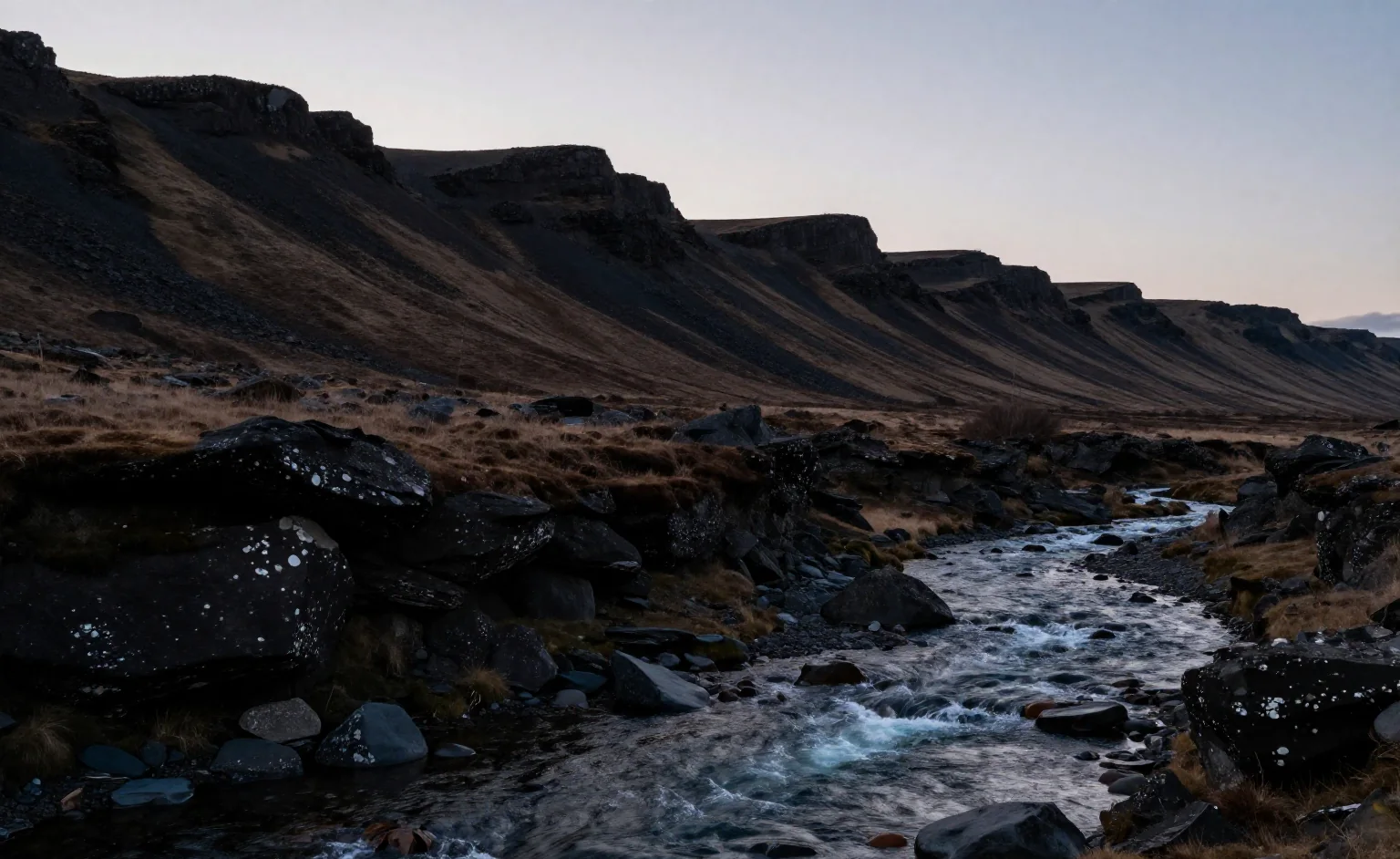
Mountains water yin yang is the easiest pairing to see because the visual difference is direct. The ridge occupies one place; the stream crosses it. The mountain seems to resist time while the water appears to spend it. The pairing becomes interesting at the boundary: wet stones, a channel cut into rock, sediment settling where the current slows. That is yin and yang in nature in one frame.
In our product photography, a dark stone can anchor the frame while a pale line of water pulls the eye away. The image works because the eye has somewhere to rest and somewhere to travel. A bracelet can create a similar rhythm, though we do not claim that its beads carry the landscape’s elemental qualities.
The five elements add another layer when kept within the source. Wood is growth and expansion; Fire is heat and ascension; Earth is grounding and nourishment; Metal is refinement and contraction; Water is flow and introspection. Their generating cycle is Wood, Fire, Earth, Metal, Water, then Wood again. That does not require assigning a gemstone to a phase the source never assigns.
Yin Yang Directions in Nature: Why South and North Matter
Yin yang directions in nature make an abstract idea physical. South is yang and north is yin. On a clear day, one side of a ridge receives more direct warmth while the other stays cooler and often retains more moisture. Moss, snow, shadow and the direction people choose for a bench all offer clues. This is yin and yang in nature read locally rather than drawn as a diagram.
The traditional directions connect to the five elements: East is Wood, South is Fire, West is Metal, North is Water, and the Center is Earth. These are classical correspondences, not guarantees about a garden’s outcome. The practical value is attentional: once you know which direction a space faces, warmth, shade, movement and stillness become related conditions.
This is also why direction is best paired with time. A south-facing wall may hold warmth after the sun has moved away; a north-facing hollow may stay cool longer into the morning. The seasonal version of the same handover is covered in our guide to yin yang seasons.
How Do You Read a Garden as a Living Exchange?
Yin and yang in nature becomes practical in a garden, where almost nothing stays in one condition. A stone path looks fixed until rain darkens it; a pond looks calm until wind crosses it. The aim is not to force the garden into a diagram, but to make relationships visible enough to guide small decisions.
Start with the still anchors, then trace the paths between them. A tree trunk, rock, bench or wall can provide yin-like repose; water, branches in wind and foot traffic provide yang-like motion. Too much fixed mass can feel stalled, while too much movement can feel restless. The balance is local, not universal.
We would not say that placing a crystal beside a pond creates a specific element or guarantees household harmony. Crystals can mark a transition, but the classical source does not assign gemstones to the five phases. Honest design begins with what is actually present: shade, water, stone, sun and the route a person takes through them. Our jewelry collection treats material and form as things to experience.
How Do You Put the Idea Into Practice?
Yin and yang in nature does not need a sacred site or a full afternoon. Pick one ordinary outdoor place and read it in three passes: still form, moving form, then the edge where the two meet. The exercise works in a park, on a balcony, beside a river or in a photograph. Repetition teaches you to see relationships rather than isolated objects.
Balancing Yin and Yang Outdoors on an Ordinary Walk
Balancing yin and yang outdoors begins with attention, not addition. On a ten-minute walk, name one thing that stays, one thing that moves, and one transition. The stays might be a wall or a tree; the moves might be water, leaves or clouds; the transition might be the wet edge of a bank. Do not decide which is more important. Let the sequence show you where the scene changes pace.
- Notice weight. Find the form that makes the scene feel settled.
- Notice motion. Follow the first moving edge your eye finds.
- Find the handover. Look at what happens where the still and moving forms meet.
- Name one change. Say how the balance shifts when a cloud passes, a breeze arrives or the light moves.
- Stop without fixing it. Leave the scene as a process rather than a verdict.
This is also useful for choosing photographs. A picture with no still anchor can feel busy, while one with no moving edge can feel inert. The composition need not contain literal water or a mountain. In the studio, we look for a visual handover before deciding whether an image feels balanced.
A Studio Exercise for Reading Any Landscape
For us, yin and yang in nature reduces to three marks in a field note: a circle for the still anchor, an arrow for the moving edge, and a line for the transition. It takes less than a minute. Over several walks, the marks reveal whether you notice the whole scene or only its dramatic parts.
The practice has an honest limitation: it does not tell you what a landscape “really means.” It only describes observable relationships. If a garden feels too busy, the notes may show that every view contains motion and none has a resting place. The exercise gives you language for an adjustment without claiming control over an outcome.
What Does the Landscape Hand Over?
The landscape hands over from stone to water, shade to sun, north to south, and one season to another. Watch the edge where the change happens rather than forcing the two sides into an abstract list. That edge is where yin and yang become visible as movement, and where the old idea stops being a badge and becomes a way of seeing.
Quick Answers About Yin and Yang in Nature
Is a mountain always yin?
No. The classical correspondence says a mountain is yin because its dominant quality is stillness, but it still changes over time. Read the relation in front of you: a ridge beside a fast stream may be the yin partner, while a crumbling slope shows the yang side of change.
Can a garden be perfectly balanced?
No single arrangement stays balanced in every light and season. Balance is a temporary relationship, not a permanent score. The useful goal is range: spaces that offer both rest and motion, with transitions that make the change between them legible.
Where do the directions come from?
The directions come from the five-element correspondences: East is Wood, South is Fire, West is Metal, North is Water, and the Center is Earth. South is also yang and north is yin. These are cultural correspondences; they should guide observation, not be presented as scientific facts or guaranteed outcomes.
Where the 6 and the 9 Meet
Yin and yang in nature keeps the pair close to the handover: the active nine and the receptive six meet in changing conditions, not fixed labels. This is the Yin 6 / Yang 9 balance we keep at the centre of 69player: stillness that makes motion readable, and motion that keeps stillness from becoming a pose. A landscape teaches that lesson without needing a lecture.
The yin and yang in nature exercise begins with one thing that holds and one thing that moves. Stand at the edge and watch what passes between them. Read the scene as a meeting rather than a verdict; you may find that a mountain is less fixed, water is less directionless, and balance is something you can notice before you try to manage it. The same habit appears in our taiji symbol guide and in the daily rhythm of our 24-hour energy guide. If you want to explore a single question about your own day, the spiritual oracle offers a quiet place to begin.