Full Moon Ritual: A Simple Version That Survives Bad Weeks

Do a full moon ritual once and the internet hands you a shopping list: a grid, a bowl, seven stones, a printed card of moon phases. Do it for four months and something less photogenic shows up. The version that survives a job change, a bad cold and the Tuesday you get home at eleven at night is much smaller than the one you bookmarked.
This is that small version. It has three moves, it takes about ten minutes, and it has one rule we refuse to bend: the practice has to be repeatable in the worst week of the month, not only in the calmest one. Below is what a full moon ritual is for, the steps we use, what to write down and release, and how crystals fit without becoming a grid.
What Is a Full Moon Ritual For?
A full moon ritual is a short, repeated pause that marks the end of a lunar month and clears attention for the next one. It is a habit of closure rather than a mechanism. Nothing in the practice requires a purchase, a specific hour, or anyone else in the room.
Closure is the word we choose on purpose. What goes wrong in a busy month is rarely a lack of intention; it is that nothing ever ends. Projects trail off, arguments stay half-finished, and the same three worries are still on the desk thirty days later. A full moon ritual that needs an hour and perfect conditions cannot fix that, because the month that most needs an ending is usually the month with no free evening in it.
What the full moon actually is, and what it is not
Physically, a full moon is the point in the month when the Moon sits on the far side of Earth from the Sun and its Earth-facing half is fully lit. NASA’s guide to moon phases describes that geometry plainly. What the geometry does not do is prescribe a practice. The ritual is a human convention laid over a visible event, and we would rather say that than dress a preference up as astronomy. You are marking a date, and the date is convenient because it is already written in the sky.
The classical material we work from does not depend on the moon at all. It is about balance arriving as movement: stillness is yin and motion is yang, and the pattern is waxing and waning rather than a fixed setting. A month that visibly fills and empties is a handy clock for that idea. Where the sources are silent we stay silent, so the moon is not assigned an element here, and we do not invent one for it. The four periods of the classical day are set out in our 24-hour energy rhythm guide if you want that side of the framework instead.
Full Moon Ritual Steps: Three Moves and Ten Minutes
Our version has three moves and a hard stop. Ten minutes in total, one of which is tidying up, and no step that depends on anyone else being awake. If you learn only this much, the practice will still be running a year from now.
- Move one, two minutes: put the day down. Lights low, phone in another room. The practice begins by ending something rather than starting something.
- Move two, three minutes: write one line. A single sentence naming what you are finished carrying this month. One line, not a list.
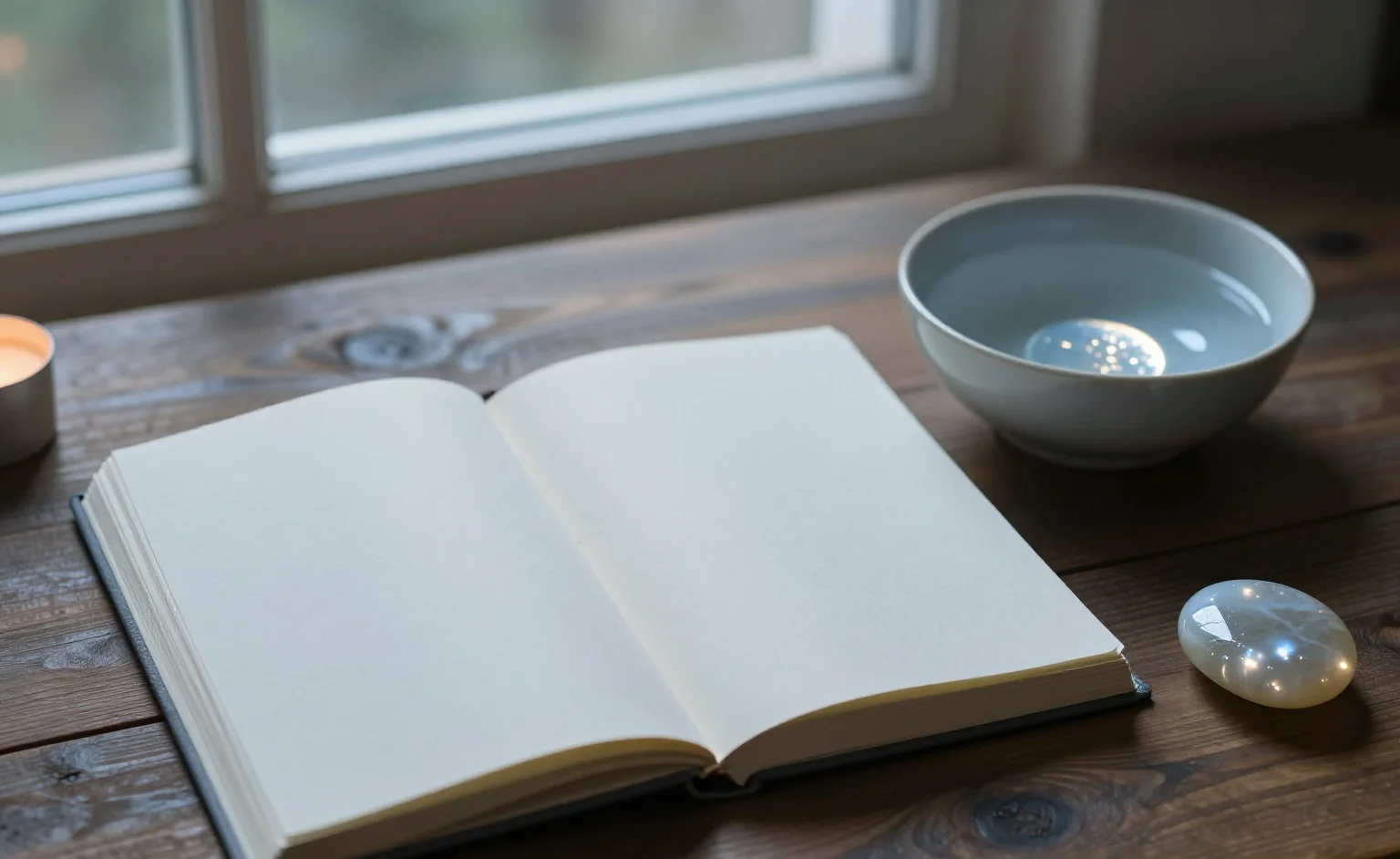
- Move three, five minutes: hold one stone and let ten exhales pass. Weight in the palm, each exhale a little longer than the inhale. Then set the stone down and stop.
Order matters more than duration, and the reason is practical. Writing before you sit still means the sentence is already out of your head when attention gets slippery. Sitting still first tends to turn into three more minutes of thinking about what to write. We tried that order for most of a year and kept losing the second half of the practice.
The hard stop is the part people skip. Setting the stone down and leaving the table is what makes an ending an ending. A full moon ritual that drifts into the rest of the evening is just one more thing the day absorbed.
The Full Moon Release Ritual: One Line, Written Down
The full moon release ritual here is exactly one sentence, written by hand on a scrap of paper. Not a list of everything you resent, and not a letter you will never send. One line, in the present tense, naming something you are done carrying.
What we ask for is specificity without drama. “I am finished re-litigating that email” beats “I release all negativity”, because one of them describes something you can actually stop doing on Wednesday. The paper goes in a drawer or straight into the bin. What matters is that the sentence exists outside your head, and that you read it once more before the month turns.
The honest limit: nobody is claiming that writing a line changes the situation. The email is still sent, the decision still stands, the difficult person is still difficult. What changes is what you keep re-reading. That is a small claim, and a small claim we can defend is worth more than a large one we cannot.
A Full Moon Ritual with Crystals: One Stone, Not a Grid
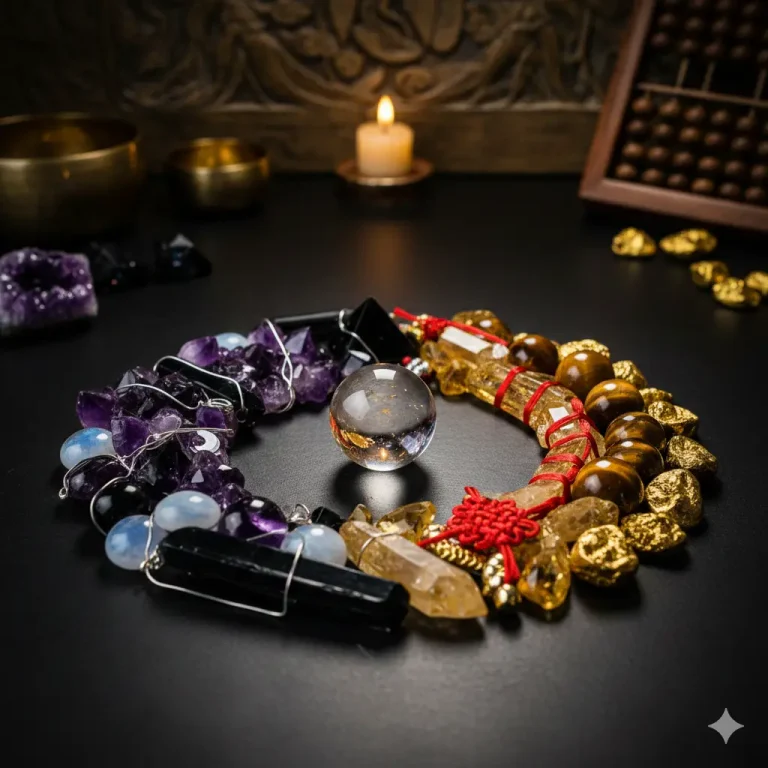
A full moon ritual with crystals works better with one stone than with a layout. In our studio the criterion is entirely physical: something with enough weight to feel in the palm, cool to the touch, smooth enough to hold for five minutes without fidgeting. Everything past that is decoration.
Crystal grids are the obvious temptation, and we say plainly that we do not build them. Partly it is honesty about sources: the classical material assigns directions and seasons to the five elements, not elements to individual gemstones, so we will not claim a particular stone belongs to a particular phase. Partly it is habit design. A grid has to be assembled and tidied away, and any practice with a build step loses to a tired evening. A single stone lives on the nightstand and asks nothing.
If you want the piece to work through the rest of the month as well, the same logic we use for choosing moonstone applies: hold it before you buy it, and let weight and surface settle the decision. Stones that live out on a windowsill collect dust, and the short routine in our crystal cleansing guide keeps a bracelet or a palm stone ready to pick up without turning care into a chore.
A Full Moon Ritual for Beginners: What Changes After the First Month
A full moon ritual for beginners is mostly a test of patience, because the first cycle feels mechanical. You will read your line, count your breaths, and suspect you are simply sitting at a table. That reaction is normal, and it is not a signal to stop.
Three things beginners usually get wrong
- Making it longer. The urge to add steps arrives around week three, and it is the most common way the practice dies.
- Buying a symbolic object. Pick something you enjoy holding, not something a list told you is correct.
- Treating a missed month as a failure. The month after a missed one is the month that proves the practice is real.
By the second or third cycle most people notice the same modest thing. The month acquires a shape: a beginning you marked and an ending you marked, with a visible middle between them. That is the whole benefit, and it is enough. The trick that keeps a morning grounding ritual alive applies here too: hang the practice on an event you cannot forget, and a full moon is a better alarm than any reminder you would set.
How Do You Keep the Practice on a Bad Week?
You keep it by lowering the bar rather than moving the date. On a bad week the full moon ritual shrinks to one move: say the line out loud, stand still for a minute, and go to bed. A shortened practice that still happens keeps the month marked; a postponed one rarely comes back at all.
The ten-minute fallback, exactly as it happens
In practice the fallback is unglamorous. The notebook stays shut because the pen has gone missing, so the line gets said out loud while the kettle boils. The stone is whatever is already in a pocket, and the ten exhales happen with the lights off. It still counts, and that is why we built the ritual this short: the version you can perform while tired and unpractised is the only version that reaches the third month.
Quick Answers About Full Moon Rituals
Do you have to do it on the exact night?
No. We do ours on the nearest evening we are actually home, which is sometimes two or three days off. The moon is a clock, not an appointment, and a full moon ritual that demands a precise hour is a ritual that quietly gets skipped.
Can you do a full moon ritual with other people?
You can, and it works when everyone writes their own line. What does not work is a shared script, because the sentence only does its job when it is yours. Two people, two pieces of paper, the same ten minutes, and then stop talking about it.
Is there a wrong way to do it?
Only one, in our view: making it big enough to fail. If your practice needs a specific stone, a clean room and a silent house, you have built something that will be abandoned by winter. Everything else is preference.
Where the 6 and the 9 Meet
This is the reading we keep returning to at 69player. Yang is the odd, active nine and yin is the even, receptive six, and the whole practice lives in the handover between them. A full moon ritual is that handover on a monthly scale: one small, deliberate ending so the next stretch of activity has somewhere to start from. That is what we mean by the Yin 6 and Yang 9 balance, and it is why the version we teach is deliberately the smallest one that still works.
Pick the next full moon, keep a stone within reach, and write one line. If you want a second opinion on which half of the month you are actually living in, the oracle tool asks a single question instead of a questionnaire, and the pieces in our collections are chosen for exactly this kind of small, repeatable use.