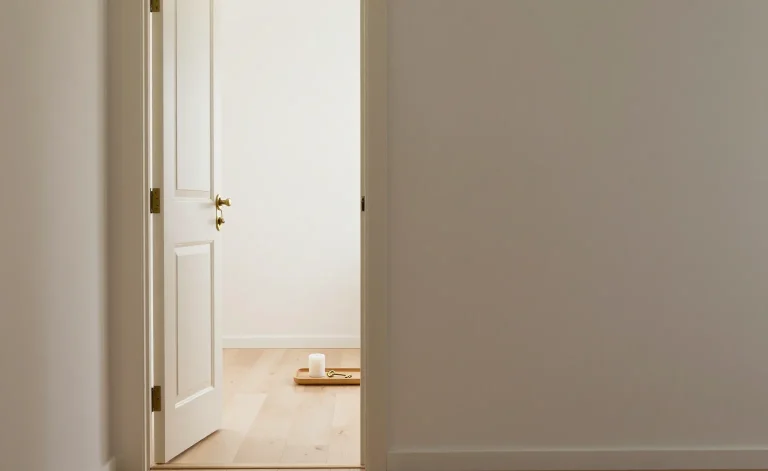
Evening Ritual for Calm: Closing the Day on Purpose

An evening ritual for calm does not need to be beautiful, long, or performed at the same minute every night. It needs a clear handover: one moment when the day stops asking for output and the body is allowed to stop bracing. In our studio we tested the smallest version we could keep for a month, and it came down to a lamp, a line of writing, and a stopping time.
We are not going to promise better sleep or a quieter mind. What we can describe is the change we noticed in the room: the desk cleared, the overhead light off, the phone face down, and a ten-minute window with nothing to finish. That is the version this article is about.
What Makes an Evening Ritual for Calm Actually Work?
A working evening ritual for calm changes the conditions around you, not your personality. It lowers the amount of light, sound and unfinished work in the room, gives the day a visible ending, and asks for one small action you can repeat when you are tired. The test is whether you can do it on a bad night, not whether it looks good on a good one.
The Handover, Not the Shutdown
In the vocabulary we use, the day is yang: motion, output and decisions. Night is yin: stillness, lower light and fewer choices. The useful evening ritual for calm is a handover between those conditions, not an attempt to switch yourself off. A handover can be clumsy. You put down one thing, pick up another, and let the room tell you which mode you are in. That is why a lamp and a cleared table do more than a complicated sequence of affirmations: they make the change visible before you have to feel it.
How to Wind Down at Night When Your Brain Is Still Moving
Start with the body before the mind. Put both feet on the floor, lower the light, and write down the one thing you are afraid to forget. The point is not to empty your head; it is to give the unfinished item a place to wait, so you can stop carrying it into the evening.
The One-Line Close
Our one-line close is deliberately small. On a notebook page we write “Done for today” followed by one thing that is actually finished, then “Tomorrow” followed by one thing that can wait until morning. No project plan, no journal entry, no review of the whole week. The line gives the day an edge. When the page closes, the evening ritual for calm has a boundary that does not depend on willpower. If you miss a detail, it belongs on tomorrow’s line, not in your head at 10 p.m.
A Calm Evening Routine That Fits a Small Flat
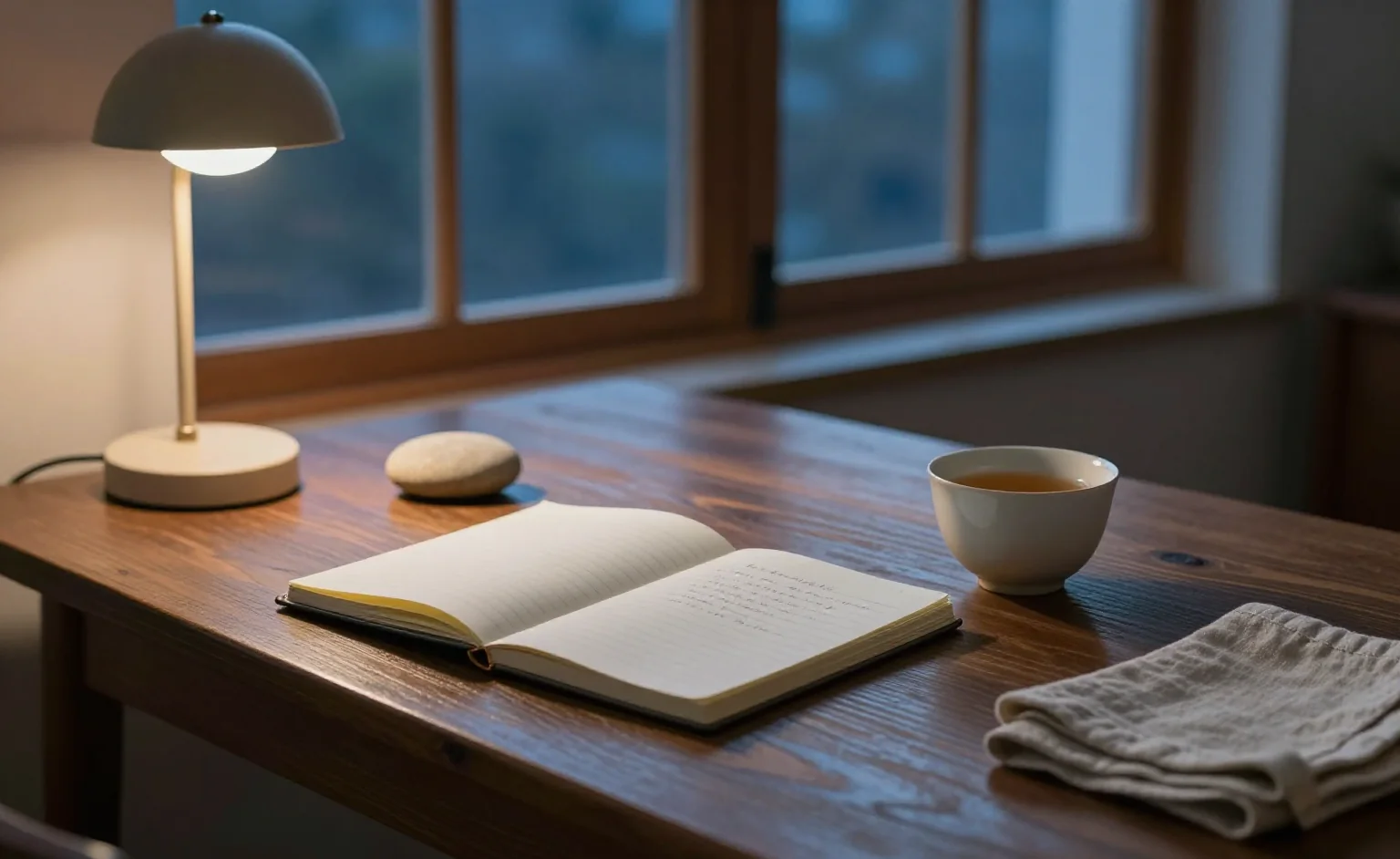
A calm evening routine has to survive the size of the room. In a studio flat, the desk is also the dining table and the place where mail lands. We clear one surface, not the whole flat: the table where the lamp sits, the cup goes, and the notebook opens. Everything else can wait behind a closed door.
Light, Sound and Temperature
Light is the cheapest change we made. The overhead bulb goes off first; a 2700K lamp takes over and pools light on one part of the table. Sound follows: no podcast, no television, no notifications, just the room and perhaps a fan or a window. Temperature matters less than people think, but a cool room with a warm lamp feels different from a warm room with a cold overhead light. We keep a light layer nearby and let the air move. None of this is a medical treatment; it is a set of signals that the working day is over.
Nighttime Grounding Ritual: Feet, Breath, One Object
A nighttime grounding ritual can be as plain as feeling the floor. Sit down, take your weight off your hands, and notice the two points where your feet meet the ground. Then take three slower breaths and place one object on the table: a stone, a cup, a closed notebook. The object is not a charm; it is a marker that the handover has started.
A Three-Breath Reset
We use three breaths, not a count to twenty. The first breath is for noticing that you are still moving. The second is for letting the shoulders drop. The third is for looking at the one object and deciding that nothing else needs to be solved tonight. If your mind wanders, that is not a failed ritual; it is the ordinary condition the ritual is designed for. The evening ritual for calm is supposed to be repeatable on a distracted night, not only on a quiet one.
Yin Energy at Night: Why Less Is the Point
Yin energy at night is not a substance you add to a room. It is a description of conditions: stillness rather than motion, cool rather than hot, dim rather than bright, north rather than south. A nighttime room already leans that way. The mistake is trying to make it more yin with more objects, more candles and more steps, until the routine becomes another task with a performance standard.
Less is the point because the day has already been loud. The evening ritual for calm works by subtraction: one light instead of five, one line instead of a journal, one stone instead of a shelf. That is also why we do not assign a crystal to a direction or promise that a particular arrangement will change your life. The sources we rely on give us the pair of conditions, not a shopping list.
What We Stopped Doing
We stopped checking email after nine, stopped using the overhead light as a reading lamp, and stopped treating the routine as a streak to protect. The streak was the worst part: one missed night turned the whole practice into a failure. Now the only rule is that the lamp goes on and the page opens for ten minutes. If we are too tired, we write one word and close the book. The evening ritual for calm still happened, just at its smallest size.
A Ten-Minute Evening Ritual for Calm, Step by Step
This is the version we use now. It takes about ten minutes, and most of that is simply being in the room rather than doing something to it.
- Minute zero to two: lower the light. Turn off the overhead bulb and switch on one warm lamp.
- Minute two to four: clear one surface. Move everything that belongs to tomorrow out of the lamp’s pool of light.
- Minute four to seven: write the one-line close. One finished thing, one thing for tomorrow, then close the page.
- Minute seven to nine: ground. Both feet on the floor, three slower breaths, one object in view.
- Minute nine to ten: stop. No extra check, no “one more thing,” no reopening the laptop.
What to Do When You Miss a Night
Do not catch up. A missed night is not a debt, and an evening ritual for calm that requires a make-up session has turned into administration. The next night starts at minute zero with the lamp, not with an apology or a longer list. If you miss a week, make the first night smaller: lamp on, one breath, page open. The routine can restart without a ceremony, which is the only reason it survives a real household.
Questions We Hear at the Studio
These are the questions that come up when people see the table and assume there is a secret object or a special order. There is not. The useful part is the stop time.
Do You Need Crystals for an Evening Ritual?
No. A stone can be a useful marker because it stays in one place and catches the lamplight, but it is not required. If you already keep a small arrangement, our note on a crystal grid ritual explains why we keep ours small. If you want a piece for the table, look at the shop; if you do not, a cup or a closed notebook does the same job.
Is Ten Minutes Enough?
Ten minutes is enough for a handover, not for a complete change of life. The evening ritual for calm is a threshold, and a threshold only needs to be wide enough to cross. If ten minutes feels long, use three: lamp, breath, one line. The shorter version is easier to repeat, and repetition is what makes the room feel different over time.
At 69player we describe the brand as a Yin 6 / Yang 9 balance: six for stillness, nine for motion. The evening is where that ratio becomes practical. The day can keep its nine parts of motion; the last ten minutes belong to the six. If you want to build the other end of the day, our morning grounding ritual is the matching piece. The full moon ritual shows the same principle at a monthly scale, and the 24-hour rhythm guide puts the handover on a clock. Start with one lamp and one line; the rest can wait until tomorrow.