New Moon Intention Ritual: One Line, One Month

A new moon intention ritual earns the name the moment it gets small enough to repeat: one sentence, written down once, read again at the full moon. We have kept some version of this practice for eleven lunar months, and the one that survived is noticeably shorter than the one we started with.
What follows is the new moon intention ritual we would hand a friend: the wording rules, the prompts on our card, where a single stone fits, and the review that closes the month. Our guide to the full moon ritual covers the other end of the cycle.
What Is a New Moon Intention Ritual For?
It is a short, repeated pause at the start of a lunar month that names one thing you want to move on. It is a habit of beginning rather than a mechanism, it needs no purchase and no specific hour, and the whole practice fits in the ten minutes before bed.
The moon here is a clock, not a power source. A new moon is the point where the Moon sits between Earth and the Sun with its unlit half facing us, which is a question of geometry rather than energy; NASA’s explanation of moon phases sets that out plainly. What the geometry does not do is tell you what to write. The practice is a human convention laid over a visible event, and we would rather say that than dress a preference up as astronomy.
Our classical material says nothing about the moon’s own nature, so we assign it no element. What the sources do give us is the pattern behind the timing: stillness is yin and motion is yang, and the year is a long handover in which winter gives way to summer as yin fades and yang grows. Starting something at the dark of the moon borrows that rhythm; it does not extend it.
Why one sentence beats a list
We tested this on ourselves. For the first three months we each wrote a list, and by the eighth month the lists had stopped being read at all. What survived was one sentence, and the difference is not effort: a new moon intention ritual lives or dies on whether it is short enough to read without opening the notebook. A list of five intentions is a plan; one sentence is a commitment a tired person can still keep.
What a new moon ritual does not promise
It does not promise that the intention arrives. Nothing in this practice changes a salary, a diagnosis or another person’s decision. What it does is make the month legible: you wrote something on a known date, and thirty days later you either did it or you did not.
New Moon Intention Setting: One Sentence, Not a List
New moon intention setting is the whole ritual on most nights: write one sentence by hand, date it, stop. The sentence describes your own action rather than an outcome, fits in fifteen words, and starts with a verb you can perform in an ordinary week.
Two examples from our notebooks show the difference. “I want to feel calmer” cannot be done or checked. “I walk twenty minutes before I open the laptop” can, because Wednesday will tell you the truth. The first version feels profound and does nothing; the second is boring and works.
Dates matter more than people expect. We write the day next to the line and keep it at the front of the notebook for the month. When the next new moon arrives the previous sentence is still in the same place, which makes comparison possible without an app or a tracker.
The wording rules we use
Four rules, and we break none of them. Under fifteen words. Present tense, as though it is already happening. One action, not two joined by “and”. Nothing phrased as a negation, because “stop scrolling at night” paints a picture of scrolling. A sentence that fails a rule gets rewritten on the spot, which takes about ninety seconds.
Where to keep the line so it gets read
The line has to be reachable on a bad day. Ours sits in the front of a notebook on the same shelf, next to the stone. Not in a phone, where a note competes with forty notifications and loses. Somewhere you pass twice a day and can open in four seconds.

New Moon Journaling Prompts That Fit on One Card
New moon journaling prompts are easy to overbuild, so ours live on one index card with four questions and no explanation. We wrote them ourselves and they are not traditional, which we say out loud, because a homemade prompt dressed up as ancient instruction is what this shop tries to avoid.
- What did last month actually take out of me? Answer in one line, not a diary entry.
- What is one thing I would notice if it changed? This is where the intention usually comes from.
- What will I do on the day it does not happen? The honest answer is usually nothing, and that is worth knowing before the month starts.
- Who already knows about this? Tell one person before you close the notebook.
The card lives inside the notebook cover, so the prompts are never hunted for. Four answers plus one sentence are a complete record, they take under ten minutes, and they complete the new moon intention ritual for that month.
Crystals for the New Moon: What We Hand People
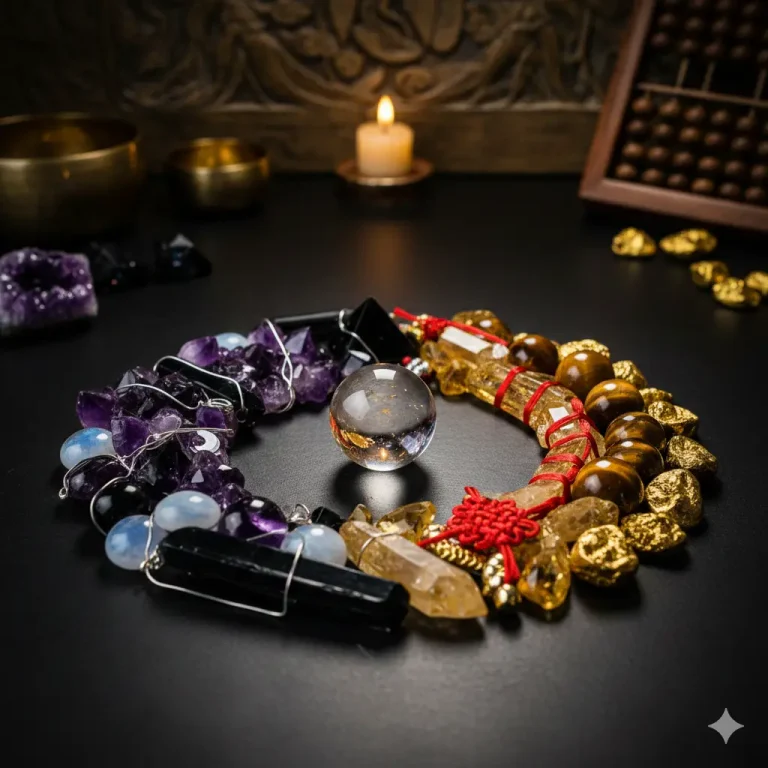
Crystals for the new moon work as they do everywhere in our practice: as a physical reminder you can hold, not a mechanism. The selection rule is entirely physical, and it is the same test we use for a moonstone — cool to the touch, enough weight to feel in the palm, smooth enough to hold for five minutes.
One stone on the notebook, for the month. That is how a new moon intention ritual with a stone stays a ritual rather than a collection, and it is why the stone lives where the sentence lives. Anything kept in a bowl on the other side of the room stops doing anything at all.
Why we do not build a grid at the new moon
A crystal grid has a build step, and a build step is what kills a monthly habit. That is a design argument rather than a metaphysical one. The classical material we rely on assigns directions and seasons to the five elements, not elements to individual gemstones, so we will not claim a crystal belongs to the new moon.
Monthly Intention Review: Ten Minutes at the Full Moon
A monthly intention review is the second half of the practice, done at the full moon rather than at the end of the calendar month. Read the sentence, answer three questions, then decide whether it carries forward unchanged, gets rewritten, or gets dropped.
The questions are short: did it happen, what made it easy or impossible, and is it still worth wanting? We write the answers under the original line, so the notebook accumulates a record rather than a series of fresh starts. A new moon intention ritual is checked here, not graded.
The review is also where we decide what “partly” means. Three walks a week when you intended four is a yes, not a failure, and that reading decides whether the practice continues into month two. Grading yourself harshly at the full moon is the fastest way to stop writing anything at the new moon.
What we do when the month went badly
When the month went badly we keep the sentence and lower the bar, in that order. The intention stays and the quantity shrinks to something possible: ten minutes instead of twenty. What we avoid is rewriting the whole thing, because a new sentence every month means no month is ever tested. A new moon intention ritual that survived a bad month is worth more than one replaced by a better idea.
Questions We Get About the New Moon
Do you have to do a new moon intention ritual on the exact night?
No. We do ours on the nearest evening we are home, sometimes two nights late, and the notebook has no idea. The new moon is a marker, not an appointment, and a practice that demands a precise hour is one that gets skipped in the week it matters.
Can two people do the new moon intention ritual together?
Yes, and it works when each person writes their own line. Read them aloud once if you like, then close the notebooks. A shared sentence does not work, because the intention only does its job when it describes one person’s ordinary week.
How is this different from the full moon ritual?
The new moon intention ritual and the full moon one are the two ends of a single month: one writes the line, the other reads it. Either alone is incomplete — a review with nothing to review is a diary entry, and an intention that is never read is a wish. Our sources divide the classical day into four two-hour periods and invent no Earth period to fill the gap; we apply the same restraint rather than padding the cycle with ceremony.
The Two Halves of One Month
That pairing is the reading we keep coming back to at 69player, where the whole idea is the balance of Yin 6 and Yang 9: the even, still six and the odd, active nine, each holding a dot of the other. A new moon intention ritual is the yin half of that exchange, which is why we keep it quiet, short and written down.
Start with one sentence on the next dark night, keep it where you will see it, and read it again in two weeks. The stones in our collection are chosen to be handled rather than displayed, the short routine in our crystal cleansing guide keeps one ready to pick up, and our morning ritual does the same job for a single day.