Yin Yang in Relationships: The Handover, Not the Halves

There is a packaged version of yin yang in relationships that arrives ready-made: one of you is the calm one, one of you is the storm, and the two of you click together like the two halves of a circle. We have watched enough households try to live inside that picture to know how it usually ends. A role assigned once is a role checked never. The symbol was never two broken halves waiting to be glued; it is one circle in motion, with the darker half and the lighter half taking turns at the front.
Two things first. Every classical statement below comes from our own brand notes on the five elements and yin and yang, and where the tradition is silent we say so rather than inventing a tidier answer. We are also a jewelry studio, not a counselling service: what follows is a reading of an old idea plus what we tried at our own kitchen table. Our version of yin yang in relationships started as a note stuck to the fridge.
What Does Yin and Yang Mean in a Relationship?
Applied to two people, yin yang in relationships describe a rhythm rather than two personality types. Stillness is yin and motion is yang, and the pair take turns leading instead of splitting the trait permanently between them. Both partners are the whole circle. The only live question is which of you is holding the active half this morning.
The common reading stops at the halves and misses the interesting part. Classical yin and yang are defined by relationship rather than by inventory: stillness is yin and motion is yang, mountains are yin and water is yang, the north is yin and the south is yang. Nothing on that list is a personality. If you want the symbol itself taken apart, our notes on the yin and yang symbol meaning cover the taiji and what the two dots inside it are doing.
Why the classical laws matter more than matching
The three classical laws are what make this usable between two people. Opposition within unity says the two sides belong to one system instead of sitting on opposite teams. Waxing and waning says the balance moves: winter into summer is yin fading as yang grows, not a draw. Mutual transformation, which the Huangdi Neijing puts as extreme cold producing heat and extreme heat producing cold, says each side turns into the other at the limit. That last law is the whole argument against fixed roles, and it is the part of yin yang in relationships that most advice skips. The Internet Encyclopedia of Philosophy’s entry on yinyang follows these ideas back through the classical texts if you want sources rather than a summary.
Yin Yang Relationship Balance: The Handover, Not the Halves
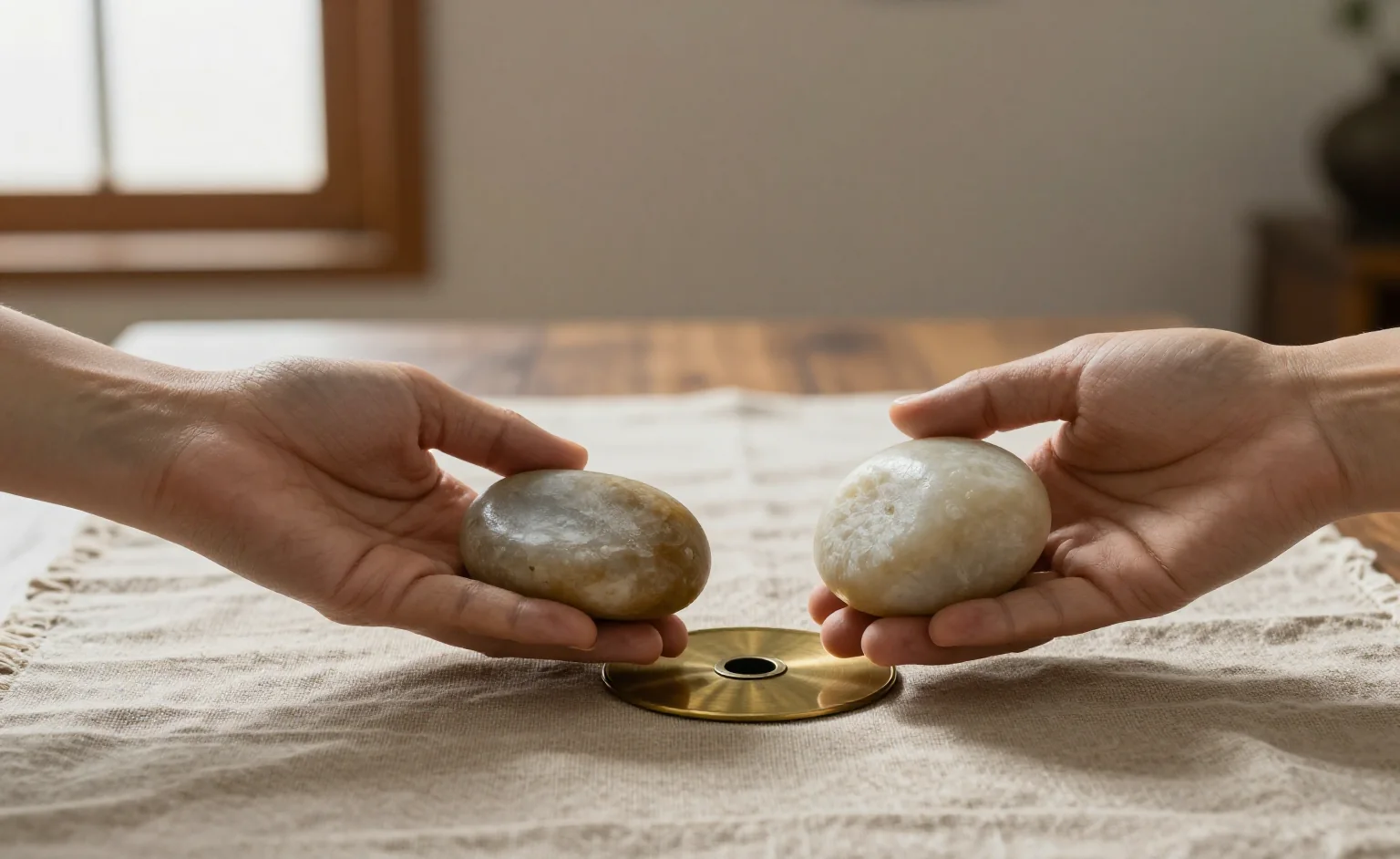
Yin yang relationship balance, read honestly, is about sequencing: who is carrying the active half right now, and whether the other person noticed. Two people rarely split those qualities evenly at any given hour, and they do not need to. They need a handover that both of them can see coming, which is a much smaller and much more practical demand.
We started saying handover instead of balance because balance sounds like a still photograph, and something balanced enough to photograph is dead weight. Most of what gets written about yin yang in relationships describes that pose. What actually happens in a shared week is a sequence of small transfers: whoever wakes first, whoever books the appointment, whoever says out loud that nothing has to happen tonight. None of those people is the yin partner. They are the person holding the active half at seven in the morning on a Tuesday.
What one week of handover looked like in our studio
Here is the honest version of our testing, small sample and all. For six weeks, three households wrote one line each evening: who led the morning, who led the evening, and whether either of them had said it out loud. The pattern was not that one person dominated. It was that the handovers nobody named were the ones that turned into friction, clustering around the third and fourth evening of a week. Naming the change cost about fifteen seconds. That is what yin yang in relationships looked like on paper for us, and three households is not evidence of anything except what our own weeks did.
How to Balance Yin and Yang in a Two-Person Week
To balance yin and yang in a shared week, name the handover instead of dividing the traits. Choose the one moment in the day where the lead actually passes, which for both of us was the evening, and say out loud who is taking it. Two or three sentences a week is enough to keep two people from both trying to be the still one, or both insisting on being the active one.
- Name the evening handover. One sentence at the point where the day turns: I have got the evening, or I am finished. It is not a chore chart, it is a marker.
- Let one of you be slow on purpose. Stillness is not a failure of energy. Whoever is carrying the active half needs someone who is not also pushing.
- Say when you took the lead by accident. Most overrun weeks are not a decision anyone made, which is exactly why nobody notices them.
Most yin yang in relationships trouble we hear about is timing rather than temperament. If the two of you are starting from a week that already feels worn out, our older piece on restoring yin and yang energy in modern life runs through the same idea per person rather than per household.
Who leads when both of you are tired?
Nobody, and that is the useful answer. On the flat days the pair does not sort itself into a leader and a follower; both halves sit at the low end of the same motion, so the honest move is to lower the bar rather than assign a role. Make the smallest version of the evening happen and let the active half wait for morning. The classical day cycle runs Wood in the early hours, then Fire, then Metal for refinement and contraction from three to nine in the evening, which is a long way of saying that decisions are cheaper tomorrow.
Yin Yang Compatibility: What This Reading Is and Is Not
Yin yang compatibility is the phrase that makes us wince, because it is usually sold as a score. So here is what this reading is not: not a personality test with a result, not a forecast about whether a relationship lasts, and not an element assigned to you at birth. The classical scheme does assign elements to directions, seasons and two-hour periods — East to Wood, South to Fire, West to Metal, North to Water, the Center to Earth. It does not hand out an element per person, and we are not going to invent that table.
People ask us for a compatibility score; we hand back a sentence about handovers instead, because that is the only part of yin yang in relationships we can point at. A reading that cannot be wrong is not a reading. If you want the version we do stand behind, it is the one that keeps asking where each of you is right now, which is the question the oracle tool was built around.
Yin and Yang in the Shared Home: Two Directions, One Room
Two people sharing a flat tend to end up with one palette and one lighting plan, which is how a home starts to feel like it belongs to whoever decorated it. The classical directions give you a cheap way to hold both. The south is yang and the north is yin, so the brightest, most active corner belongs to daylight and to the work you say out loud, while the north side of the room is where the reading chair, the low lamp and the quiet shelf live. That is not a fortune-telling rule, and we would not dress it up as one. It is the room-sized version of yin yang in relationships, and it works without anyone having to say anything. The same handover happens at the front door, which our entryway notes lay out.
Quick Answers About Yin Yang in Relationships
Does one partner have to be the yin and the other the yang?
No. That is the fixed-role reading, and the classical laws argue against it. If waxing and waning happens inside a single day, the same person is more yang at nine in the morning and more yin at eleven at night. Two people who each move through both halves have more room than two people guarding one trait each. For whatever a small sample is worth, that is what our six-week notebook suggested.
What if one of you is more yang all year?
Then the other one is carrying a lot of stillness, and the useful question is whether that was chosen. Some people genuinely run warm: the one who plans, books and starts. That works while the quiet half is resting on purpose, and it turns into resentment when the quiet half is simply the backlog of things nobody asked for. Name the handover weekly rather than daily for a month and you will see which of the two it is. The 24-hour rhythm guide is the same idea stretched across one day.
Where the 6 and the 9 Meet
This is the idea we keep coming back to at 69player. Yang is the odd, active nine and yin is the even, receptive six, and the pairs that last are rarely the ones who split those two numbers between them once and for all. They are the ones who keep handing them back and forth. That is the Yin 6 and Yang 9 balance as we understand it: not a property you have, but a motion you keep making. The version of yin yang in relationships worth keeping is small enough to fit in a night’s note.
So skip the quiz and take one week instead. Each evening, write one line about who carried the active half, say the handover out loud when it happens, and read the notes at the end. That will tell you more about your own two-person circle than any symbol can, and it costs fifteen seconds a night. The pieces in our collections are made for exactly this kind of reminder: something that sits in the hand, rather than another theory to remember.