
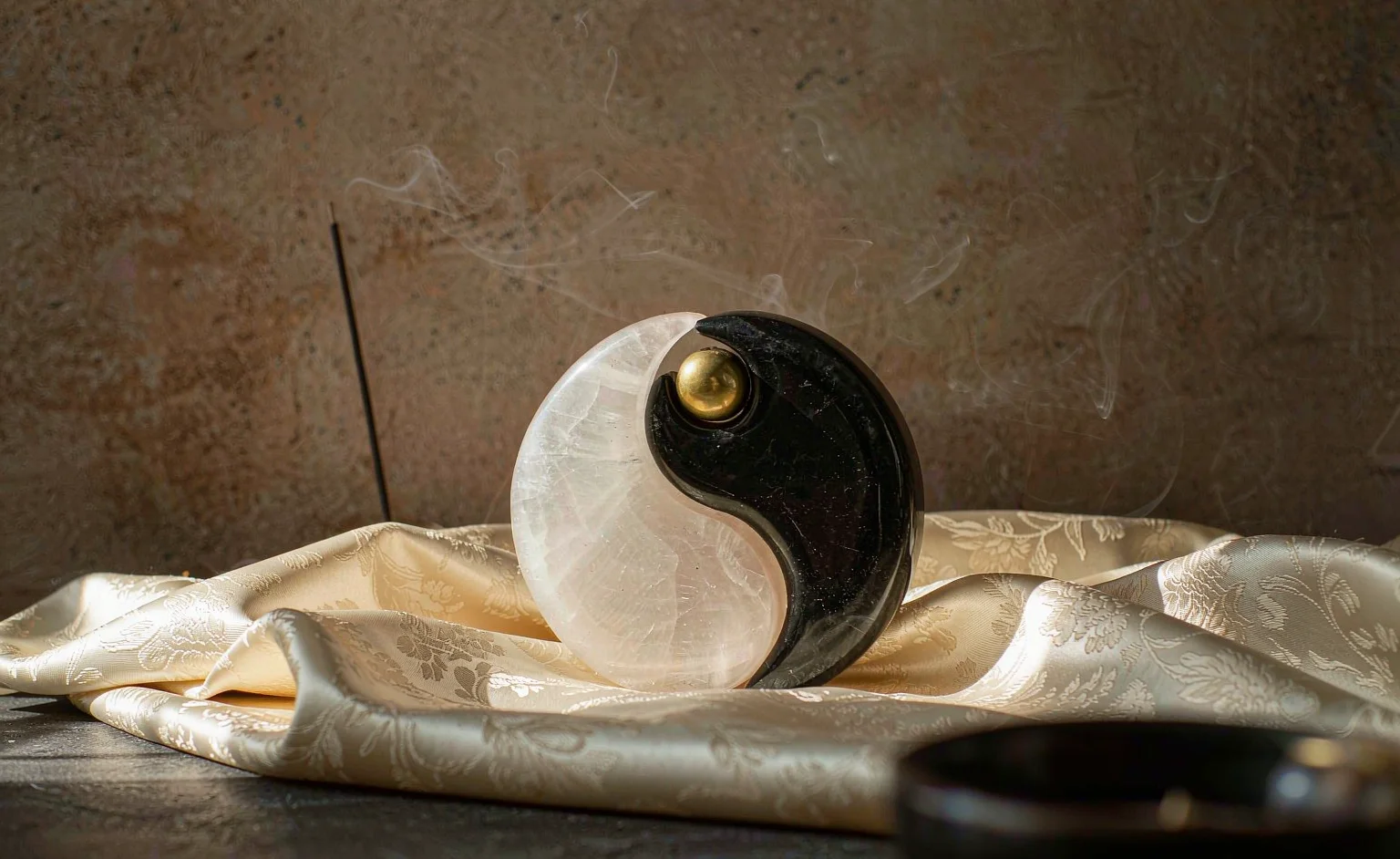
Morning Grounding Ritual: A Ten-Minute Start That Holds All Day

There is a particular kind of tired that comes from starting the day at full speed. You are awake for four minutes, you have read six messages, and your shoulders are already somewhere near your ears. A morning grounding ritual exists to interrupt exactly that. It is not a productivity system and it is not a stretch routine; it is a short, deliberate pause at the front of the day, before the first demand arrives.
We have watched this practice spread through our studio for one plain reason: it survives bad mornings. Ten interrupted minutes are still ten minutes that happened. What follows covers what a morning grounding ritual is in the classical framework, how to ground yourself in the morning without adding an item to your list, which stones we keep within reach, and what to do when your attention refuses to settle.

What Is a Morning Grounding Ritual, and Why Does It Work?
A morning grounding ritual is a short repeated practice, usually one to ten minutes, that settles body and attention before the day’s demands begin. It works because it puts the still, receptive half of the day in front of the active half, instead of trying to recover stillness after the day has already spent it.
That ordering is the trick, and it reverses how most of us treat rest. Rest as a reward arrives late, watered down, and negotiable, which is why evenings so often end in a scroll rather than a stop. Move a little stillness to the front instead, and the day starts from a settled baseline rather than from whatever the inbox said first. For the other end of the day, our evening ritual for calm closes the loop.
Why does stillness come first in the classical view?
Classical Chinese thought gives a plain answer: stillness is yin and motion is yang, and the two take turns leading rather than competing for the same hour. Mountains are yin and water is yang; the south is yang and the north is yin; warmth is yang and cold is yin. Read that way, a morning grounding ritual is not a soft start. It is the yin half of the day doing its work before the yang half asks for anything, which is why we treat the first minutes of the morning as the cheapest stillness you will get all day.
Where the morning sits in the classical day cycle
The classical day cycle divides the hours into four periods. The early morning belongs to Wood, growth and expansion, roughly three to nine. Then Fire, heat and ascension, nine to three; then Metal, refinement and contraction, three to nine in the evening; then Water, flow and introspection, nine at night to three in the morning. Four periods, not five, so we do not invent an Earth hour to fill the gap. Earth’s quality is grounding and nourishment, and it belongs to the Center and to Late Summer, which is why grounding is a quality you can call on at any hour rather than a slot on the clock.
Now look at the first hour you are awake. It is Wood time: beginnings, first drafts, the part of the work that expands rather than polishes. A short still start borrows thirty seconds from the top of that block and hands the rest back sharper. Our guide to the 24-hour energy rhythm walks through the whole day.
How to Ground Yourself in the Morning Without Adding Another Task
How to ground yourself in the morning comes down to one rule: attach the practice to something you already do, and keep it shorter than feels reasonable. The version below takes about ninety seconds, needs no mat and no app, and works in a kitchen, a bathroom, or a parked car.
- Feet first. Feel the floor for thirty seconds before you touch a screen. Weight is the fastest route back into the body.
- One long exhale. Not a breathing exercise, just an exhale longer than the inhale. Two or three are enough to notice a change of pace.
- Name the first task. Say out loud which single thing the morning is for. Wood rewards beginnings, so choose the task that opens the day, not the one that closes it.
- Hands on something cool. A stone, a glass of water, a door handle. Touch does more in ten seconds than a paragraph of intention does in five minutes.
- Protect the first minute. No messages until step four is done. The practice collapses if the phone arrives first.
None of these steps is impressive, and that is deliberate. The value of a morning grounding ritual is that it happens on mornings you did not sleep well and did not plan ahead. A practice that needs thirty good minutes is abandoned by Thursday; one that fits inside ninety seconds is still there in March.
Grounding Stones for Calm Mornings: What We Keep Within Reach
Grounding stones for calm mornings are not a separate category of mineral. In our studio the phrase means the stones you can hold in one hand during a morning grounding ritual while your attention lands. The useful property is physical: weight, coolness, and a surface smooth enough to keep your fingers busy while the rest of you slows down.
We are careful here, because the classical attributions are specific and easy to overstate. The five elements assign directions and seasons, not individual gemstones, so we do not claim that a particular crystal belongs to an element. What we can say is more modest: a stone with real weight in the palm gives the hand something to do, and a hand that is busy is not reaching for a screen. Keep one on the nightstand and one by the kettle, and the practice will find you.

A bracelet works the same way and asks less of you, because a reminder you put on in the morning is a reminder you do not have to remember. The pieces in our collections are chosen with that in mind, and if mornings are the hardest part of your day, our notes on crystals for anxious and stressful seasons help you choose something you will actually wear.
A Morning Routine for Calm Energy in Five Minutes
A morning routine for calm energy does not need to be long; it needs to be ordered. Five minutes is enough when the sequence moves from the body inward, because each step makes the next one easier instead of demanding a state you have not built yet.
The five-minute sequence, step by step
- Minute one: stand still. Feet flat, hands loose, no screen. Let the body arrive before the mind is asked anything. Boredom here is normal.
- Minute two: breathe out longer. Three exhales, each a little longer than the inhale. Keep the shoulders out of it; this is a pace change, not a performance.
- Minute three: hold a stone or a warm cup. Weight and temperature are the fastest anchors in a kitchen, and neither costs anything.
- Minute four: name the day’s one beginning. One task, said out loud, that opens the day. Wood is the phase of expansion, so expansion goes first and refinement waits for the afternoon.
- Minute five: drink water and go. End on purpose. A ritual without an ending becomes a delay, and the point of a morning grounding ritual is to start the day, not postpone it.
Two of these steps on a rushed morning is still a complete practice. Sequence matters more than duration, and a version you repeat badly beats one you plan perfectly and skip. Even two steps, feet and exhale, is a real morning grounding ritual.
Grounding Meditation for Beginners: Sixty Seconds Is Enough
Grounding meditation for beginners is the entry version of a morning grounding ritual: one minute, one object of attention. Sit, feel your feet, follow the exhale. That is the whole instruction, and a minute done daily teaches more than an hour attempted once.
What if your mind will not settle?
Good news: it does not have to. A mind that will not settle is not a failed meditation, it is the ordinary starting condition, and the classical framework expects it. Opposition within unity, the first of the three classical laws, says the restless half of you is not the enemy of the quiet half. When attention wanders, return to the feeling of the floor and begin again. The returning is the practice.
One more classical law matters here: mutual transformation, described in the Huangdi Neijing as extreme cold producing heat and extreme heat producing cold. Balance is a movement rather than a setting, and yin waning as yang grows is the same slow handover that happens inside a single morning. That is why the oracle tool is built around one question about where you are right now rather than a long self-assessment.
Quick Answers About Morning Grounding Rituals
How long before it feels natural?
Most people tell us the first week feels mechanical and the second feels easier to remember than to skip, which is the sign a habit has taken hold. Give it ten mornings, and if you miss a day, resume the next morning rather than restarting the count.
Is a morning grounding ritual better than an evening one?
Both work, and they do different jobs. An evening version helps close a day; a morning grounding ritual sets the terms before the day gets a vote. If you can protect only one, choose the morning, because a steady start makes the whole day easier to order.
Do you need to buy anything?
No. The mechanics are free: feet, exhale, one beginning. Objects help, because a reminder you can feel in your hand beats one you have to remember, and that is what our bracelets are for.
Where the 6 and the 9 Meet
This is the idea we return to most often at 69player. Yang is the odd, active nine and yin is the even, receptive six, and the practice lives in the handover between them. That handover is what we call the Yin 6 and Yang 9 balance, and a morning grounding ritual is its smallest honest demonstration: a few minutes of stillness, given on purpose, so the active hours have something to draw on rather than something to borrow.
Start tomorrow with one step and no equipment. Stand still for thirty seconds before you pick up your phone, say the day’s one beginning out loud, and let the morning start from there. The rhythm is free, and it takes less time than the scroll you were about to skip.
Related Notes
For the wider rhythm, read yin and yang balance through the day and nine ways to restore yin and yang energy. If your morning practice includes a bracelet, the crystal cleansing guide covers how to reset it.