Crystal Grid Ritual: Why We Keep Ours Small

Most crystal grid instructions online begin with a photograph of twenty stones and a diagram you are meant to print. Ours begins with a table the size of a dinner plate. A crystal grid ritual, as we use the phrase in the studio, is a small arrangement of stones placed on purpose and left alone for a while: five stones, one centre, four corners, ten minutes to set up. It is a way of making a decision visible, not a machine that produces an outcome.
We have kept the same five-stone version for two years, through two small apartments and a narrow shop counter. What follows covers the classical frame we use, a beginner’s setup, four steps, and where we draw the line on what a crystal grid ritual can do.
What Is a Crystal Grid Ritual, and What Is It Not?
A crystal grid ritual is an arrangement of stones placed in a deliberate pattern and left in place for a set period. It is not a script you have to memorise, and it is not a mechanism. The stones do not act on the room; the arrangement gives your attention somewhere to rest and gives a decision a physical shape you can walk past.
Most grid instructions skip that distinction. They describe a layout as if the geometry were doing the work, then add a list of outcomes. A crystal grid ritual is closer to setting a table for a conversation than to wiring a circuit. The care you take is real, and the effect worth claiming is one you can notice: you pause, you place, you say one sentence, and the sentence stays where you can see it.
Where does the direction idea come from?
The classical scheme we use assigns qualities to directions: East is Wood, growth and expansion; South is Fire, heat and ascension; West is Metal, refinement and contraction; North is Water, flow and introspection; the Centre is Earth, grounding and nourishment. That is a scheme of correspondences, not a map of stones. The texts behind it do not assign gemstones to elements, so we do not either. When we place four outer stones, they mark four positions and four kinds of attention. They do not become Wood, Fire, Metal and Water because we put them down.
Crystal Grid for Beginners: Five Stones and a Clear Table
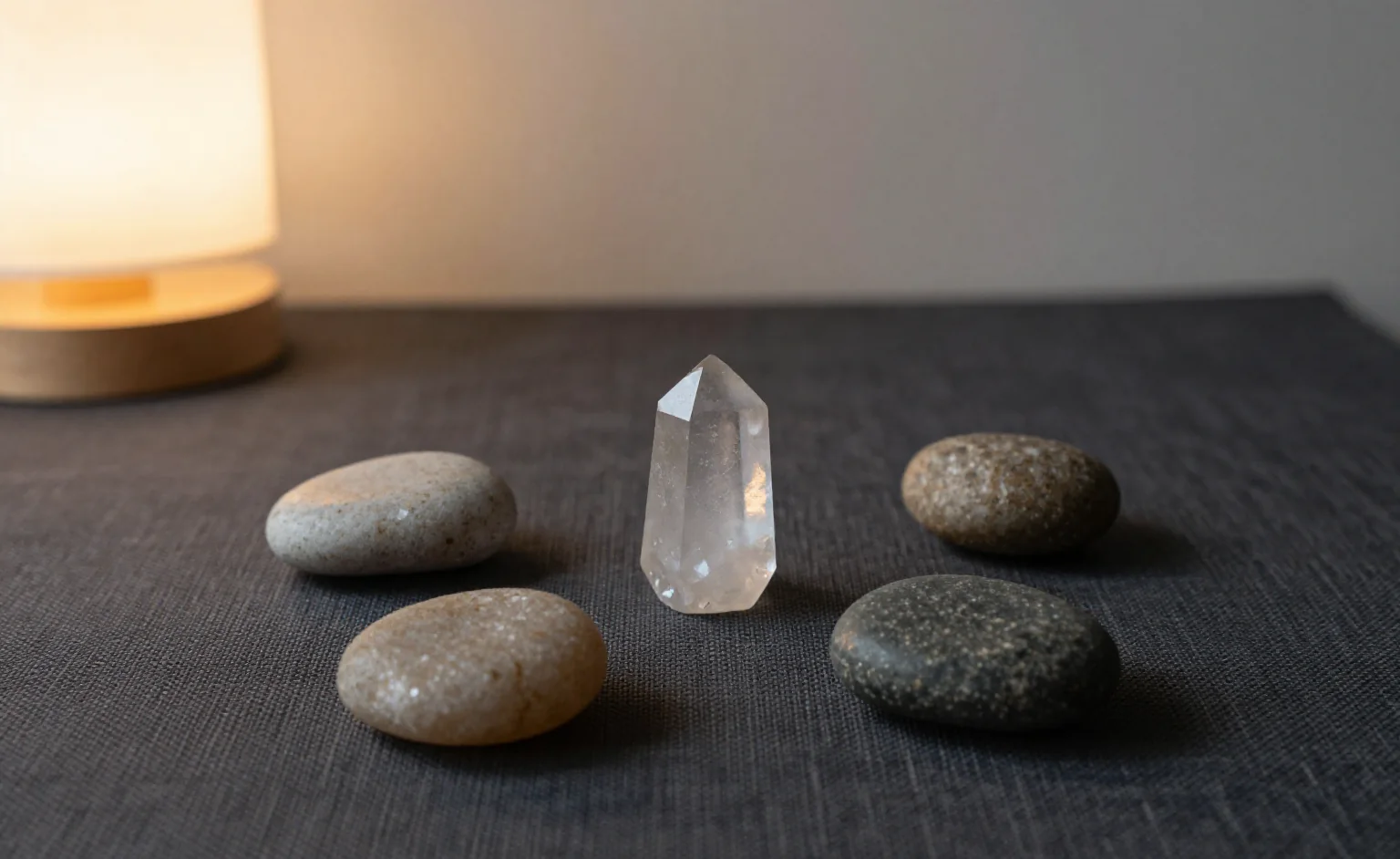
A crystal grid for beginners does not need a kit, a cloth with a printed mandala, or a full set of matching points. It needs five stones you already like touching, a flat surface, and enough empty space around the arrangement to see its outline. Our first grid used four tumbled river stones and one clear quartz point that had been sitting in a drawer for a year.
- One centre stone. A clear quartz point is the usual choice because it stands up and reads as a marker. Any stone with a distinct shape will do.
- Four outer stones. Similar size, roughly 20 to 25 mm, so the square looks deliberate rather than accidental.
- A plain surface. Dark linen, a wooden tray, or bare table. Patterned cloth competes with the layout.
- Ten clear minutes. Not a whole evening. The first setup takes longer; after a week it takes three minutes.
Which stone goes in the centre?
Put the stone you want to look at in the centre, and make it the one that is easiest to recognise from across the room. In practice that means a point, a palm stone, or a single bead with a different colour. The centre is a visual anchor first. We avoid telling people that a particular mineral belongs in the middle for a particular problem, because that claim would need a correspondence the knowledge we use does not contain.
How to Make a Crystal Grid in Four Steps
How to make a crystal grid comes down to sequence, not shopping. Clear the surface, place the centre, place the four corners, and say the sentence. The whole thing fits inside the time it takes a kettle to boil, which is why it survives an ordinary Tuesday.
- Clear the surface. Wipe the table and remove everything else. A grid surrounded by receipts is a pile with a stone on top.
- Place the centre. Set it slightly off the exact middle if that looks better to you. The shape should feel settled, not measured with a ruler.
- Place the four corners. Work clockwise, leaving a palm’s width between the centre and each outer stone. Keep the square loose.
- Say one sentence. Present tense, specific, and about your own action rather than a result you are demanding. Then stop and leave it.
We timed this in the studio: six minutes the first time, mostly spent looking for the linen, three minutes once the stones had a home. That number is the point. A crystal grid ritual that takes an hour gets done once and photographed; one that takes three minutes gets done on the days you need it.
What do you say while placing the stones?
One sentence, said out loud or under your breath, in the present tense. “I am finishing the draft before I answer anyone” is a good sentence. “I will receive good news” is not, because it asks the grid to deliver something and gives you nothing to do. The sentence is the part of the ritual that travels with you after the stones are back in their drawer.
Crystal Grid Layout: Centre, Four Corners, Nothing Else
A crystal grid layout works best when it has one idea. Ours is a centre and a square, with roughly 15 to 20 cm between the centre and each corner. That is small enough to fit beside a laptop and large enough that the shape reads at a glance. We have tried the twelve-stone version with a ring of points and a border; it looked impressive in a photograph and became clutter by the second week.
The extra stones were not neutral. Each one added a decision: which point faces where, whether the small chips count, what to do when the cat moved two. A smaller crystal grid ritual removes those decisions, and removing decisions is most of what makes a ritual repeatable. If you want a richer layout later, add one stone at a time and live with it for a month.
Can you use a printed grid cloth?
Yes, and we keep one folded in a drawer for workshops. A printed cloth is useful when several people need to find the same positions quickly. For daily use we prefer plain linen, because the geometry is already in the stones and the cloth adds a second pattern the eye has to sort out. If you use one, choose faint lines over a dense mandala and treat them as guides.
Do Crystal Grids Work? What We Can and Cannot Claim
If by work you mean produce a measurable physical effect, we cannot claim that and have not measured one. If you mean create a fixed point of attention that survives a busy week, then yes: a grid can do that, and that is the only claim we make for the crystal grid ritual we keep.
We have sold stones for years, and we have met people who say a grid changed a situation. We do not believe that proves the arrangement caused it, and we are not going to borrow their story as evidence for a product. What we can describe is our own pattern: on the weeks when the grid stayed on the table, we noticed it. On the weeks when it went into a drawer, we forgot the sentence we had set. That small, ordinary result is enough to keep the practice.
What would count as evidence?
An honest test would need a comparison the practice cannot really provide: the same person, the same week, with and without the stones, and a way to rule out the attention itself. We do not have that. So we track the one thing we can see, which is whether we return to the practice. If a crystal grid ritual makes you pause once a day for a month, it has done something real in your week. Whether the stones caused it stays open.
Keeping the Ritual Alive Without Adding Clutter
The failure mode of a crystal grid ritual is not skepticism. It is dust. A grid left in place for months becomes furniture, and furniture stops being noticed. We reset ours at the start of each month: lift the stones, wipe the linen, put them back in a slightly different order, and say a new sentence. The reset takes eight minutes and does more than adding another stone ever did.
One crystal grid ritual is enough. A second grid in another room splits the attention the first one was meant to gather, and it doubles the surface you have to keep clear. If your space is small, use a tray so the whole arrangement can move from table to shelf without being rebuilt.
What we do at the end of the month
We read the sentence we set, decide whether it happened, and write one line about why or why not. Then the stones go back to the shelf for a day. The gap matters: it stops the arrangement from becoming wallpaper. When the grid comes back out, the new sentence competes with nothing, which is the clearest condition for choosing one about the month ahead.
Where the 6 and the 9 Meet
A five-stone grid is mostly stillness with one deliberate action, which is why it fits the idea we build around at 69player: the Yin 6 and Yang 9 balance. The centre is the still half, the four corners are the moving half, and the ritual is the handover between them. You place, you pause, and then you go back to the day with one sentence in view.
If you want to build the rest of the practice around it, our ten-minute morning grounding ritual covers the start of the day, and the new moon intention ritual is the monthly version of the same one-line habit. For placement questions outside the grid, see our notes on feng shui crystal placement; for keeping the stones clean, the bracelet cleansing guide applies to grid stones too. The pieces we keep on our own tables come from the shop.
Start with five stones and a clear table. Set one sentence, leave it for a week, and see whether you notice it on the way past. That is the whole test, and it costs less than the diagram you were about to print.