Labradorite Meaning and Benefits: The Stone That Changes Colour

There is a moment in our studio when a strand of flat grey beads turns electric blue, and it almost always happens because somebody has just moved the lamp. The labradorite meaning and benefits people ask us about live in that gap between the two states: what the stone is said to do, and what it demonstrably does with light.
Here is the split we keep in our own notes. The half you can check with your eyes is geology. The half about protection and transformation is modern popular stone lore, and we label it as such rather than dressing it up as an old Chinese correspondence, because the classical material we usually write from assigns no stones to the five elements. This guide walks the labradorite meaning and benefits in that order, and it covers the two things nobody tells a first-time buyer: the flash is not permanent, and it will not look at your desk the way it looked in the listing.
What the Labradorite Meaning and Benefits Actually Cover
The material is a plagioclase feldspar, a cousin of the minerals that make up most of the Earth’s crust, and it takes its name from the Labrador coast in Canada, where it was described in 1770. Its signature is not colour in the ordinary sense: a labradorite bead is grey, sometimes nearly black, and the blue, green or gold appears only when light meets the stone at a particular angle. Holding that in mind makes the labradorite meaning and benefits easier to carry. One column is what the trade and the crystal community say the stone is for; the other is what the material does on your wrist.
Labradorite Colour Change Explained: Thin Layers, Not Pigment
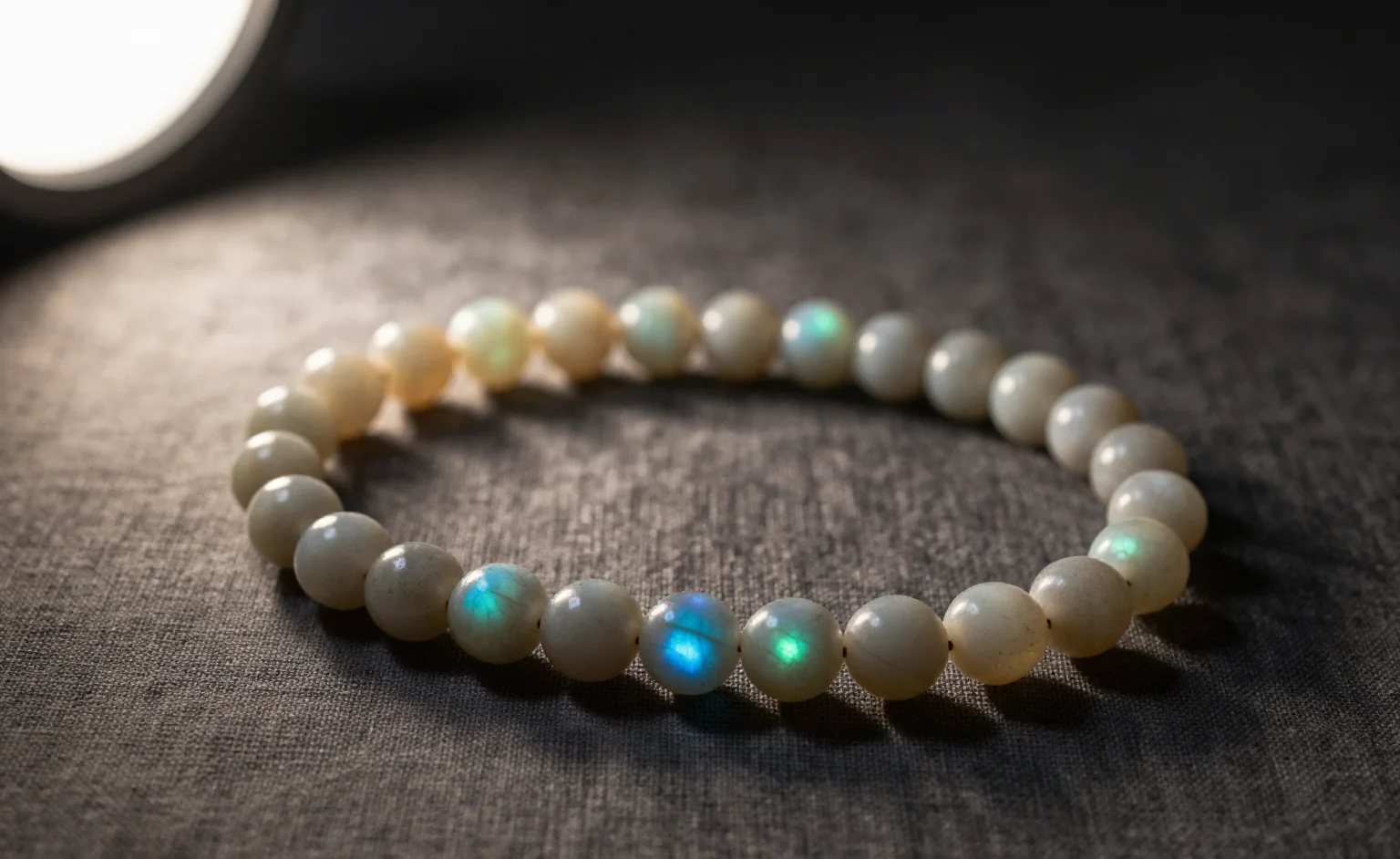
Labradorite colour change explained simply is this: there is no blue pigment in the stone. Light enters the bead, bounces between microscopic internal layers of slightly different feldspar composition, and only some wavelengths come back to your eye. The flash appears at one angle and vanishes at the next, and nothing about the stone has changed — only your position has.
That mechanism is called labradorescence, and it is the least mystical part of the labradorite meaning and benefits, which is exactly why we open with it. Because the layers sit inside the stone rather than on its surface, polishing cannot create the flash and ordinary wear cannot remove it. What wear can do is hide it: a scratched face or a waxy finish from a cheap tumble scatters the returning light, and the colour goes muddy from every angle except one.
Why the flash disappears when you tilt the bead
Tilting changes the angle between the lamp, the internal layers and your eye, and interference only works inside a narrow window. Holding a bead straight on under a shop light is the single best way to make a quiet stone look expensive. Turn your wrist two centimetres and the colour can vanish. None of that is a defect; it is feldspar behaving like feldspar. The practical consequence is that you should never judge a labradorite bracelet from one photograph, ours included.
What our bench test showed
We laid twenty-eight beads from one batch on the bench, single layer, under overcast window light. Nine of them showed any flash at all. Then we switched off the window and swung one warm lamp across the row at roughly arm’s length, and twenty-three lit up, most of them green with two in blue. Same stones, same hour, two different verdicts. That is why we photograph this stone with one lamp instead of soft daylight, and it is the honest caveat behind every product photo of labradorite: the camera stands where the flash is.
The cost of saying that out loud is that our own listings look less dramatic than the ones shot with each bead rotated to its perfect degree. We would rather you liked the bracelet on day thirty than on day one. If the flash is the reason you are buying, the labradorite meaning and benefits that survive daily wear are the quieter ones: a strand that sits grey on your wrist and lights up when you move your hand.
What Does Labradorite Do? Sorting the Claims From the Finish
Ask what does labradorite do and you get two answers in two currencies. The popular reading says it steadies you through change and keeps your energy from being spent on other people’s moods. The verifiable reading is smaller: a hard, cool, heavy stone that catches light in a way glass and plastic cannot imitate.
The first answer is a claim about outcomes, and we will not sell you one. What we can report is what customers describe, and it is almost never dramatic. People who wear a labradorite bracelet for a month mention the same two things: they fiddle with the beads while deciding something, and the colour change during the day interrupts whatever loop they were in. Both are properties of wearing a cool, heavy object and looking at it, which is the only part of the labradorite meaning and benefits we will put our name to.
Is labradorite good for beginners?
Is labradorite good for beginners? In practice, yes. It scores about six to six and a half on the Mohs scale, so it outlasts softer stones in daily wear, it is grey enough to work with any outfit, and the entry price is low. One caution: do not buy it expecting permanent colour.
The stone rewards handling and punishes expectation. A first-time buyer who shops for the flash and then inspects the bracelet in flat daylight at home will sometimes see plain grey and conclude they were cheated. Nothing went wrong. The colour was there in the light where you met the stone, and it returns whenever the light lines up again. If the strand is a gift, our first-bracelet notes cover sizing and packaging, which matter more in the first month than the labradorite meaning and benefits do.
Labradorite vs Moonstone: Two Feldspars, Two Effects
Labradorite vs moonstone is the comparison buyers ask for most often, because both are feldspars, both arrive grey-white, and both get called mysterious. The difference is in the effect. Moonstone shows adularescence: a soft sheen that drifts across the whole face like mist behind glass. Labradorite shows labradorescence: discrete patches of blue, green or gold that switch on and off as the stone moves. One is a glow, the other is a signal.
Which you want depends on how much attention you like your jewellery to draw. Moonstone is the quieter choice and reads warmer against skin; labradorite is the one people stop and ask about, and it photographs far less reliably. We wrote a longer piece on moonstone meaning and benefits, and the short version is that moonstone is a sheen stone while labradorite is an angle stone. Set both strands on the same cloth and let a lamp cross them, and the labradorite meaning and benefits come out as the more active half of the pair.
How to Care for Labradorite: Water, Heat and Everyday Wear
How to care for labradorite comes down to two numbers and one habit. The numbers are six to six and a half on the Mohs scale, hard enough for a bracelet and soft enough that quartz dust, a tiled floor or a car key can still mark it. The habit is to treat the strand like a camera lens rather than a rock: warm water, a drop of mild soap, a soft brush, then a full dry before the bracelet goes back in its box. Store strands separately, because feldspar scratches feldspar and a hazed surface is what turns a flashing bead into a plain one, and keep the strand away from sudden heat, since the internal cleavage planes behind the labradorite meaning and benefits dislike both that and long soaks.
Does labradorite need charging or cleansing?
Does labradorite need charging or cleansing? Not to keep working as jewellery. Nothing in a stone runs down, and the flash after any ritual is the flash before it. If you enjoy the practice, moonlight or a dry resting place is gentle and costs nothing. Avoid long soaks and ultrasonic tanks.
That last warning is the part people skip. Soaking a feldspar for hours is a slow way to reach the internal planes that make it interesting; an ultrasonic tank does the same thing in ninety seconds. The rest of our routine, including the parts that are ritual rather than maintenance, is in the piece on cleansing a crystal bracelet.
Quick Answers About Labradorite Meaning and Benefits
Is labradorite expensive?
Less than its appearance suggests. Beads with a strong, even flash cost more than plain ones, and the dark high-flash Finnish material costs more again, but a strand still sits at the entry level of the crystal market. Price tracks the flash you can see, so buy the strand you can see under a lamp rather than the one in a photograph. Our shop lists what we have with the same one-lamp honesty, and we would rather show you a plain grey strand than a bead rotated to its best angle.
Where does most labradorite come from?
Madagascar, Finland and Canada supply most of what reaches the trade, with Madagascar the largest single source of the beads we handle. Labrador itself, the Canadian coast the stone is named for, is still worked and is known for a darker, high-flash material. The colour is not a reliable regional signature: excellent blue comes out of more than one mine, and dull material comes out of all of them. Trust the bead, not the label.
Where the 6 and the 9 Meet
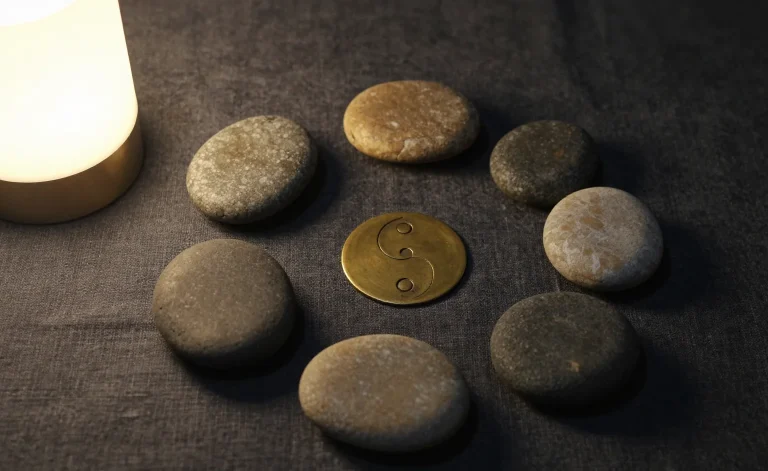
This is the thread we keep pulling at 69player. Yin is the even six, the still half: the grey bead sitting quietly on the cloth. Yang is the odd nine, the moving half: the lamp, the tilt, the flash that only arrives once something shifts. They are not opponents; they are the same object in two states, which is the oldest idea in the material we write from, and our piece on the taiji symbol follows it further. It is also why we describe the Yin 6 and Yang 9 balance as a handover rather than a scoreboard.
Labradorite may be the most literal stone we carry for that idea, and it is why we are content for the grey beads to outnumber the flashing ones. The labradorite meaning and benefits come down to that afternoon on the bench: a grey strand, one warm lamp, and your own hand deciding where the light lands.